
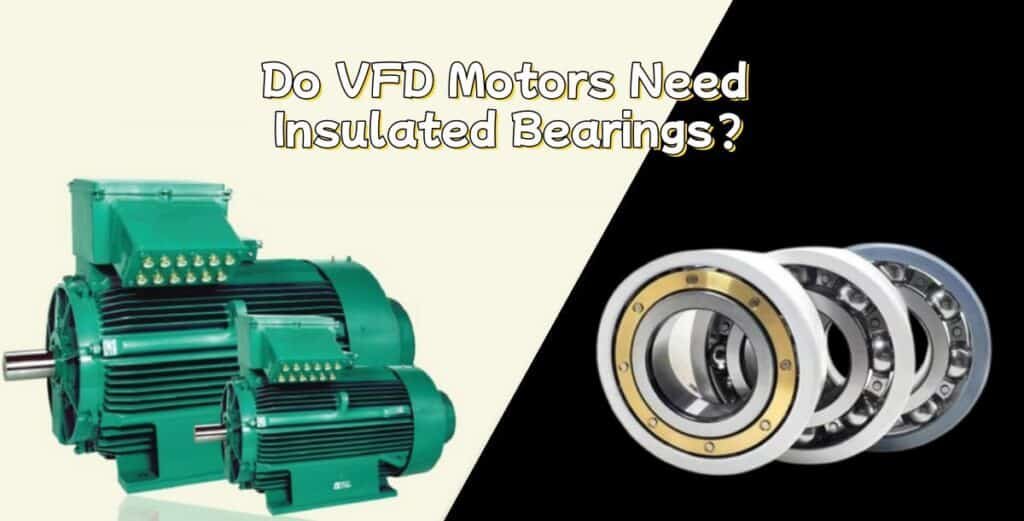

Variable frequency drives (VFDs) are now standard across HVAC, manufacturing, oil and gas, and material-handling systems in North America. While they offer precise speed control and energy savings, VFDs also introduce electrical stress that can severely shorten motor bearing life. Understanding when insulated bearings are required—and how they prevent electrical discharge damage—is crucial for engineers, maintenance teams, and equipment procurement professionals seeking long-term motor reliability.
In this complete guide, you will learn:
- How VFDs generate electrical stress, shaft voltage, and damaging bearing currents
- The mechanisms behind EDM, pitting, fluting, and lubrication degradation
- The types of VFD-induced bearing currents and how each affects motor performance
- When insulated bearings are necessary based on motor size, drive configuration, and application
- The advantages and limitations of ceramic-coated bearings, hybrid bearings, and insulated housings
- Alternative mitigation methods such as grounding rings, insulated couplings, and filters
- Selection criteria for choosing the right bearing protection strategy for industrial motors
Let’s begin by defining VFD bearing problems and the electrical mechanisms that cause premature failure.
What Are VFD Motor Bearing Problems? (Definition & Failure Modes)
What is VFD-induced bearing damage?
VFD-induced bearing damage refers to electrical erosion caused by shaft voltage and high-frequency discharge currents traveling through the bearing. These currents occur when the shaft becomes electrically charged and the lubrication film can no longer insulate the rolling elements from the raceway.
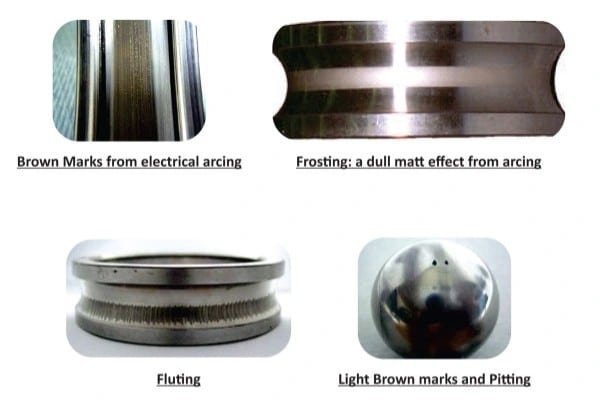
Common failure modes: EDM, fluting, pitting, microwelding, lubrication degradation
Typical electrical failure modes include:
- EDM (Electrical Discharge Machining): Instantaneous discharge that leaves micro-craters on bearing surfaces.
- Pitting: Thousands of microscopic craters produced over time.
- Fluting: Washboard-like patterns caused by repetitive EDM strikes, producing characteristic noise and vibration.
- Microwelding: Localized fusion when discharge energy is high enough to melt metal.
- Lubrication degradation: Arcing oxidizes and carbonizes grease, reducing lubrication life.
Why VFD motors are more vulnerable compared with line-powered motors
VFDs generate high-frequency switching signals that create common-mode voltage and capacitive coupling inside the motor. This raises shaft voltage levels dramatically compared with motors operating on fixed-frequency (line) power, making bearing damage far more likely.
How VFDs Create Electrical Stress in Motor Bearings (Working Principles)
How a VFD controls motor speed (rectification → DC bus → PWM switching)
A VFD first rectifies AC power into DC, stabilizes it on a DC bus, and then uses high-frequency PWM switching to synthesize variable-frequency AC power. These switching pulses create rapid voltage transitions (high dV/dt) that couple into the rotor and bearings.
High-frequency common-mode voltage & shaft voltage generation
Common-mode voltage develops due to asymmetry between the three PWM output phases. This voltage charges the motor shaft through capacitive coupling, raising the electrical potential until it discharges through the bearings.
Leakage currents, capacitive coupling & circulating currents
Three primary mechanisms contribute to bearing current formation:
- Leakage currents: High-frequency currents that escape through unintended ground paths.
- Capacitive coupling: Voltage transfer across stator–rotor, rotor–bearing, and winding-to-frame capacitances.
- Circulating currents: Large-frame motors develop rotor-to-frame current loops that pass through both bearings.
Electrical Discharge Machining (EDM) & How It Damages Bearings
Mechanism: dielectric breakdown of lubricant film
Under normal conditions, the lubricant film acts as a dielectric barrier. When shaft voltage exceeds the lubricant’s film strength, it breaks down and allows an instantaneous electrical arc to pass through the bearing.
Microwelding → pitting → fluting patterns
Each EDM discharge melts microscopic metal particles. Over time, these events accumulate into pitting and ultimately produce fluted raceway patterns that generate tonal vibrations and acoustic noise.
Audible symptoms, vibration signatures & early warning indicators
Technicians can identify early electrical damage through:
- High-frequency vibration peaks around harmonics of running speed
- Distinctive “washboard” whine in bearings
- Darkened or burnt grease
- Premature lubrication breakdown during inspection
Types of VFD Bearing Currents
Capacitive discharge currents (most common in small–medium motors)
These fast-rise-time pulses occur when the shaft voltage exceeds the lubricant film resistance. They are the primary cause of EDM damage in motors under 100 HP.
Circulating currents (dominant in larger-frame motors)
Large motors have greater magnetic imbalance and wider physical geometry, leading to rotor-induced circulating currents that flow through both bearings simultaneously.
Rotor-shaft-to-ground leakage paths
Leakage currents arise from high-frequency common-mode voltage returning through the motor frame and grounding system. Poor grounding increases this risk significantly.
When Do VFD Motors Need Insulated Bearings?
Conditions requiring insulation
Insulated bearings are typically recommended when one or more of the following conditions exist:
- Motors above 100 HP where circulating currents are more prevalent
- Long cable lengths that increase common-mode voltage
- High switching-frequency drives (typically above 6 kHz)
- Applications with frequent starts/stops where film strength fluctuates
- Critical reliability installations such as chillers, compressors, and process pumps
When insulated bearings vs. shaft grounding rings are recommended
Grounding rings are highly effective for smaller VFD motors, while insulated bearings are usually preferred in large motors where circulating currents dominate. Many OEMs specify insulated bearings on the non-drive end (NDE) of motors above 100 HP as standard practice.
When both insulation and grounding are required
High-value equipment or systems with sensitive electronics often require a hybrid approach: insulated bearings on one end and a grounding ring on the opposite end to fully control current paths.
Types of Bearing Insulation Technologies
Ceramic-coated bearings
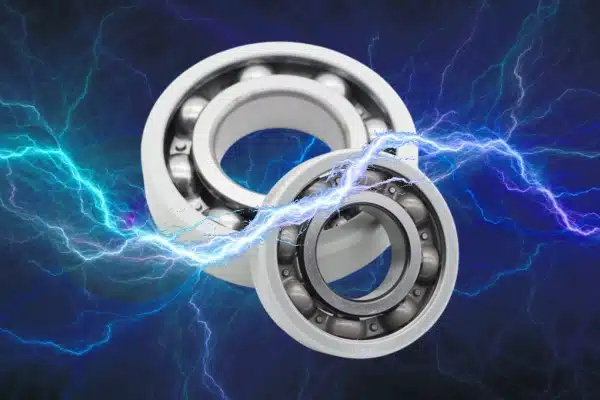
These bearings feature an insulating ceramic layer applied to the outer or inner ring. They offer high resistance, long service life, and are commonly used in industrial VFD motors.
Hybrid ceramic bearings
Hybrid bearings use ceramic rolling elements with steel rings. Because ceramic balls are nonconductive, they prevent current flow while also reducing friction and heat generation.
Insulated housings & end shields
Some motor designs use insulating sleeves or coated endbells to isolate the bearing electrically. This approach can be effective when bearing replacement is difficult or undesirable.
Pros/cons & cost differences
- Ceramic-coated bearings: Cost-effective but may require precise surface treatments.
- Hybrid ceramic bearings: Highest performance but significantly more expensive.
- Insulated housings: Useful for large motors but increases assembly complexity.
Other Mitigation Strategies Beyond Insulated Bearings
Shaft grounding brushes/rings
Grounding rings provide a low-impedance path for shaft voltage and are highly effective for VFD-driven motors under 200 HP.
Insulated couplings
Insulated couplings prevent circulating currents from flowing into driven equipment such as pumps or gearboxes.
Common-mode chokes / dv/dt filters / sine-wave filters
These components reduce high-frequency switching noise and common-mode voltage at the drive output.
Cable shielding & grounding best practices
Proper bonding, shielded motor cables, and minimizing cable length reduce shaft voltage generation at the source.
Selection Guide: How to Choose the Right Bearing Protection
Motor size, voltage & frame considerations
Larger motors naturally experience higher circulating currents, making insulated bearings a preferred solution.
Installation environment & cable length impact
Longer cable runs and harsh industrial environments increase the risk of electrical stress and bearing discharge.
Drive switching frequency selection
Reducing switching frequency can lower shaft voltage but may affect motor acoustics and drive performance.
Total cost of failure vs. prevention
The cost of insulated bearings is minor compared with the expense of unplanned downtime, motor replacement, or production loss.
Maintenance, Inspection & Troubleshooting
How to identify bearing fluting and pitting
Technicians should inspect for washboard patterns, micro-craters, and discolored lubricant during scheduled maintenance.
Vibration analysis & electrical measurement methods
High-frequency vibration peaks and shaft voltage measurements help detect electrical damage before catastrophic failure.
Lubrication issues caused by electrical discharge
EDM rapidly oxidizes grease, leading to increased friction, elevated temperatures, and accelerated wear.
Expected lifespan with vs. without insulation
Insulated bearings can increase motor life by several years in VFD applications, especially in continuous-duty industrial systems.
Applications Where Insulated Bearings Are Commonly Required
HVAC systems with long VFD cable runs
Rooftop units, air handlers, and chillers often require insulation due to long wiring distances and high switching frequencies.
Pumps, compressors, fans in industrial plants
Process motors frequently run under VFD control and are exposed to high electrical stress for extended periods.
Mining, oil & gas, paper mills, and other VFD-heavy industries
These sectors depend heavily on VFD-driven equipment, making insulated bearings essential to avoid production downtime.
Frequently Asked Questions (FAQ)
Do all VFD motors require insulated bearings?
No. Small motors generally benefit more from grounding rings, while medium and large motors often require insulation.
Can shaft grounding rings replace insulated bearings?
Grounding rings are effective for capacitive discharge currents, but circulating currents in large motors still require insulation.
How much shaft voltage is dangerous for bearings?
Even shaft voltages as low as 10–20 V can trigger EDM discharge when lubrication film conditions are weak.
What is the difference between fluting and pitting?
Pitting consists of random micro-craters; fluting forms patterned ridges caused by repetitive electrical discharge over time.
Can insulated bearings eliminate all bearing currents?
No. Insulation blocks current through that bearing, but circulating currents may still flow unless grounding or filtration is added.

2 条评论
Pingback: Wind Turbine Insulated Bearings: The Ultimate Protection Guide
Pingback: Can a Standard Bearing Be Replaced With an Insulated One?