
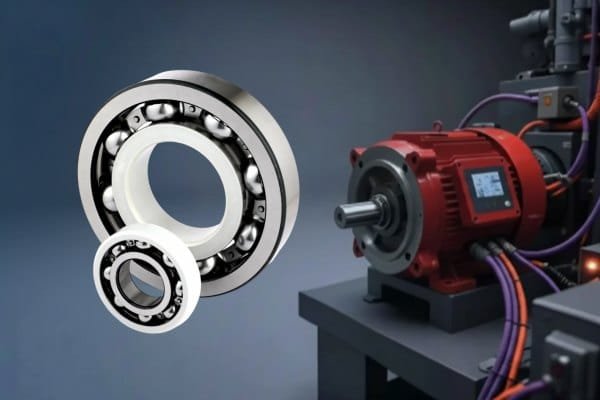

The rise of Variable Frequency Drives (VFDs) has unlocked incredible efficiency for industrial motors, but it has also unleashed a silent destroyer: stray electrical currents. For plant managers and maintenance engineers, protecting these expensive assets is critical. One of the most robust defenses against electrical bearing damage is the use of insulated bearings. However, choosing the right type—whether coated or hybrid ceramic—and installing it correctly requires specific technical knowledge.
In this buyer’s guide, you will learn:
- Why VFDs generate damaging common mode voltage and circulating currents.
- The critical differences between Coated (INSOCOAT) and Hybrid Ceramic bearings.
- Application rules: When to insulate the Drive End (DE) vs. the Non-Drive End (NDE).
- A cost-benefit analysis comparing insulated bearings to shaft grounding rings.
- Best practices for installation to ensure the insulation layer remains intact.
Let’s explore how to create an impenetrable barrier against electrical erosion.
Why VFD Motors Require Insulated Bearings? (The Problem)
Standard steel bearings are electrical conductors. In a traditional line-fed motor, this isn’t an issue. But in a VFD system, the motor shaft becomes part of an electrical circuit.
The VFD Effect: PWM and Switching
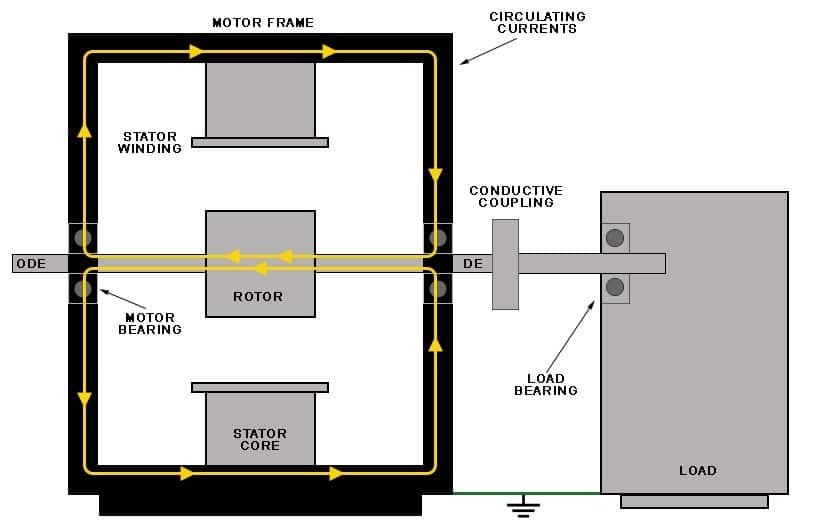
VFDs control speed using Pulse Width Modulation (PWM). The high-frequency switching of the drive’s transistors creates a non-zero “Common Mode Voltage” on the motor windings. Through capacitive coupling, this voltage is induced onto the rotor shaft, looking for a path to ground.
The Specific Threat: High-Frequency Circulating Currents
In larger motors (typically above 100 HP / 75 kW), magnetic asymmetry in the stator creates a high-frequency flux. This flux induces a voltage loop along the shaft. The current flows down the shaft, through the drive-end bearing, through the frame, and returns through the non-drive-end bearing. This is a circulating current loop. If not broken, it destroys both bearings rapidly.
Types of Insulated Bearings: Which Should You Choose?
There are two primary technologies available. Selecting the right one depends on your budget and motor size.
1. Coated Bearings (e.g., INSOCOAT)
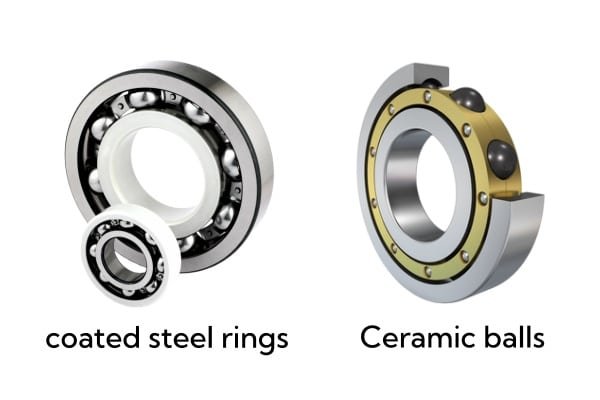
Technology: These standard steel bearings feature a thin layer of plasma-sprayed aluminum oxide (ceramic) on either the outer or inner ring surfaces. This coating provides electrical resistance, typically insulated up to 1,000V or 3,000V DC.
Best Application:
- Large motors (>100 HP) where the primary goal is to stop circulating currents.
- Retrofitting existing motors (drop-in replacement dimensions).
Pros & Cons:
- Pros: Cost-effective for large sizes; high load capacity (same as steel).
- Cons: The coating is thin and can be scratched during improper installation; it acts as a capacitor itself, allowing some very high-frequency current to pass.
2. Hybrid Ceramic Bearings
Technology: These bearings replace steel rolling elements with Silicon Nitride (Si3N4) ceramic balls. Ceramic is a natural electrical insulator.
Best Application:
- Smaller VFD motors (under 100 HP) prone to EDM discharge.
- High-speed applications or harsh environments with poor lubrication.
Pros & Cons:
- Pros: Superior electrical isolation (virtually infinite resistance); lower friction; longer grease life; harder and more durable than steel.
- Cons: Higher upfront cost (typically 2-3x standard bearings); lower static load rating in some cases.
Application Rules: Drive End (DE) vs. Non-Drive End (NDE)
Where you install the bearing is just as important as which one you buy.
Strategy 1: Breaking the Circulating Loop
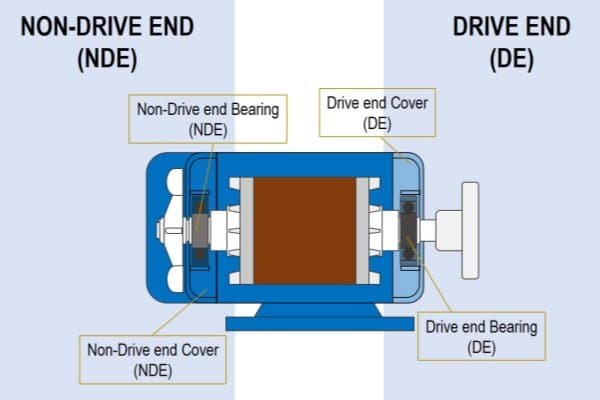
For large motors suffering from circulating currents, you typically only need to break the loop at one point. The standard practice is to install an insulated bearing on the Non-Drive End (NDE). This stops the current from flowing through the frame, protecting both bearings.
Strategy 2: Total Isolation
For smaller motors or applications with high shaft voltages (EDM risk), installing Hybrid Ceramic bearings on both ends is the ultimate protection. This completely isolates the rotor from the frame.
Insulated Bearings vs. Shaft Grounding Rings (Comparison)
Should you block the current or bleed it off?
| Feature | Insulated Bearings | Shaft Grounding Rings (SGR) |
|---|---|---|
| Mechanism | Blocks current (High Impedance) | Diverts current (Low Impedance) |
| Maintenance | Zero (Sealed inside motor) | Minimal (Rings may wear over time) |
| Reliability | Very High (Physical barrier) | High (Dependent on shaft contact) |
| Cost | High Initial Cost | Moderate Initial Cost |
ROI Analysis
While an insulated bearing may cost $500 compared to a $50 standard bearing, avoiding a single unplanned downtime event (which can cost $10,000+ per hour in production loss) yields an ROI of thousands of percent instantly. For VFD motors, the “premium” bearing is actually the cheapest option over the lifecycle.
Installation and Maintenance Best Practices
To ensure your investment pays off:
- Protect the Coating: When installing coated bearings, never strike the insulated ring directly with a hammer. Use a fitting tool or induction heater. A scratch or crack in the ceramic coating ruins the insulation.
- Housing Fits: Ensure the housing bore is clean. Metal burrs can bridge the insulation.
- Grease: Hybrid bearings run cooler and stress the grease less, often allowing for extended lubrication intervals.
Frequently Asked Questions (FAQ)
Are insulated bearings worth the extra cost?
For any critical motor driven by a VFD, yes. The cost of premature removal, rewind, and re-installation far exceeds the price difference of the bearing.
Do I need insulated bearings for non-VFD motors?
Generally, no. Unless there is a known issue with magnetic asymmetry or external static discharge, standard steel bearings are sufficient for line-driven motors.
Can I retrofit a standard motor with insulated bearings?
Yes. Insulated bearings are manufactured to standard ISO dimensions. They are direct “drop-in” replacements for standard bearings.

一条评论
Pingback: Bearing Insulation Thickness: Impact on Dielectric Strength