
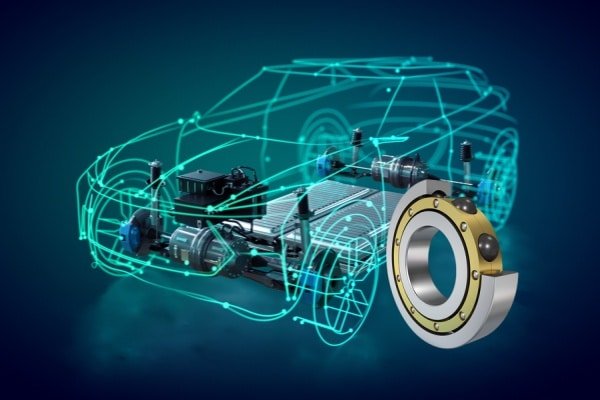

The rapid shift to e-mobility presents unique engineering challenges. As Electric Vehicle (EV) architectures migrate from 400V to 800V platforms and adopt Silicon Carbide (SiC) inverters, the electrical stress on traction motor bearings has increased exponentially. For automotive OEMs and Tier 1 suppliers, ensuring the reliability of these components is paramount. Standard steel bearings are no longer sufficient; insulated bearings, specifically hybrid ceramic technologies, have become the new industry standard. They not only prevent electrical failure but also unlock performance gains essential for modern drivetrains.
In this automotive industry guide, you will learn:
- How high-voltage 800V architectures and SiC switching create destructive shaft voltages.
- Why Hybrid Ceramic bearings are the preferred solution over coated bearings for EVs.
- The impact of bearing choice on NVH (Noise, Vibration, and Harshness) in silent vehicles.
- How hybrid bearings contribute to extended vehicle range through friction reduction.
- A commercial comparison of technologies for traction motor applications.
Let’s analyze why the future of EV propulsion spins on ceramic balls.
The New Challenge: High Voltage & SiC Inverters
Electric traction motors operate in a harsh electrical environment that far exceeds industrial standards.
How 800V Architectures Increase Electrical Stress
To achieve faster charging and higher efficiency, the industry is moving towards 800V battery systems. Higher DC bus voltages result in higher Common Mode Voltages. Furthermore, modern inverters use Silicon Carbide (SiC) semiconductors that switch at incredibly fast speeds (high dV/dt). This combination generates potent high-frequency voltage pulses that easily capacitively couple to the motor shaft.
The Failure Mode: Electrical Discharge Machining (EDM)
Without protection, this shaft voltage discharges through the oil film of the bearings. In an EV motor spinning at 15,000 to 20,000 RPM, this leads to rapid micro-arcing (EDM), causing pitting and fluting. In a combustion engine, engine noise might mask early bearing damage. In a silent EV, the “whine” of a fluted bearing is immediately audible and unacceptable to the driver.
Why EV Motor Bearings Must Be Insulated
Insulation is not just about preventing failure; it is about customer experience and warranty costs.
Preventing Premature Failure: The Warranty Cost Issue
EV electric drive units (EDUs) are typically “sealed for life.” Replacing a failed rotor bearing often requires replacing the entire drive unit, leading to massive warranty claims. Insulated bearings act as an insurance policy against this catastrophic expense.
Noise, Vibration, and Harshness (NVH)
EV owners expect a quiet ride. Bearing fluting creates a distinct, high-pitched tonal noise that penetrates the cabin. By preventing electrical erosion, insulated bearings maintain the pristine NVH characteristics of the vehicle throughout its lifespan.
The Solution: Hybrid Ceramic Bearings (The EV Standard)
While industrial motors often use coated steel bearings, the automotive sector has largely coalesced around Hybrid Ceramic Bearings (steel rings with Silicon Nitride balls).
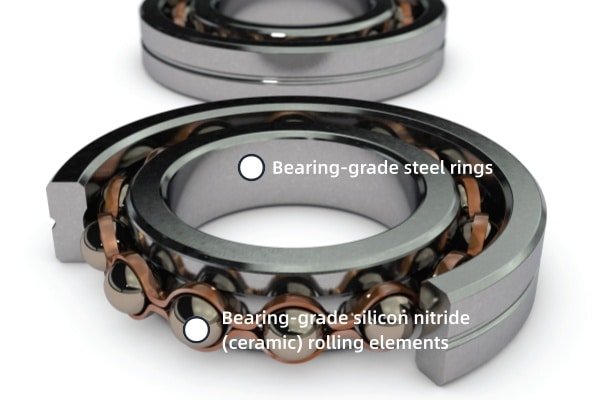
Dual Benefit: Electrical Insulation + High-Speed Performance
Ceramic balls are naturally non-conductive, offering the highest level of electrical isolation. Crucially, silicon nitride is 40% lighter than steel. At traction motor speeds (20,000+ RPM), this lower mass significantly reduces centrifugal force, skidding, and heat generation, which is critical for high-speed durability.
Efficiency Gains: Extending Vehicle Range
Range is the key selling point for any EV. Ceramic balls are harder and smoother than steel, resulting in lower rolling friction. Switching to hybrid bearings can contribute to a measurable improvement in overall drivetrain efficiency, directly translating to increased range per charge.
Comparing Technologies: Coated vs. Hybrid for Automotive
Why not use cheaper coated bearings?
Why Plasma Coatings are Limited
Plasma-sprayed coatings (like INSOCOAT) add thickness to the bearing ring, which can be challenging to package in compact EV motors. More importantly, under the extreme high-frequency switching of SiC inverters, thin coatings can act as a capacitor, leaking current. They are also prone to mechanical damage during the automated press-fit assembly processes used in automotive mass production.
Cost vs. Performance
While hybrid bearings have a higher unit cost, they offer a “drop-in” solution that solves electrical, thermal, and mechanical speed challenges simultaneously. For OEMs, the total value proposition—reliability, efficiency, and simplified assembly—favors hybrid technology.
Application Guide: Traction Motors vs. Auxiliary Motors
Not all motors in an EV need the same protection.
- Main Traction Inverter: Hybrid bearings are mandatory due to high power, high voltage, and high duty cycles.
- E-Axle Bearings: Often require ceramic balls to handle the combined electrical and mechanical loads.
- Auxiliary Motors (e.g., A/C Compressor): May use lower-cost solutions or conductive grease, though premium models are shifting to hybrids for longevity.
Frequently Asked Questions (FAQ)
Why are hybrid bearings used in electric vehicles?
They solve two problems at once: they electrically insulate the shaft to prevent EDM damage, and their lightweight ceramic balls handle the extreme RPMs of EV motors better than steel.
Can conductive grease replace insulated bearings in EVs?
No. Conductive grease cannot reliably handle the high-frequency currents from SiC inverters and often degrades too quickly for “sealed for life” automotive applications.
How do bearings affect electric vehicle range?
Bearings contribute to parasitic friction loss. Hybrid ceramic bearings have lower friction than steel bearings, meaning less battery energy is wasted as heat, leaving more energy for driving range.
