
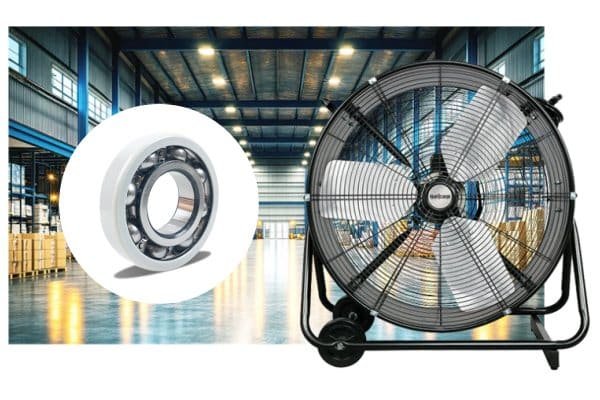

In HVAC systems, manufacturing plants, and data centers, industrial fans are the lungs of the facility. To maximize energy efficiency, the vast majority of these fans are now driven by Variable Frequency Drives (VFDs). While VFDs offer precise airflow control, they introduce a hidden threat: high-frequency shaft voltages. For maintenance teams, the result is often a puzzling cycle of bearing replacements, excessive vibration, and “burnt” grease. The solution lies in specifying the correct protection: insulated bearings.
In this industrial guide, you will learn:
- Why VFD-driven fans are uniquely susceptible to electrical bearing damage.
- How to distinguish between aerodynamic noise and the “fluting” whine of a damaged bearing.
- Selection criteria for Coated vs. Hybrid bearings in high-speed fan applications.
- Insulation strategies for Center-Hung vs. Overhung fan configurations.
- The overlooked role of static electricity generated by air friction.
Let’s explore how to keep your fans spinning smoothly and silently.
Why Industrial Fans Are Vulnerable to Bearing Failure
Fans operate differently than pumps or conveyors, making them highly sensitive to bearing quality.
The VFD Standard: Efficiency vs. Electrical Risk
Over 90% of new industrial fans utilize VFDs. The drive’s Pulse Width Modulation (PWM) switching creates common mode voltage on the motor shaft. Because fan motors often run at high speeds for long durations, the number of electrical discharge events (EDM) accumulates rapidly, accelerating failure.
High-Speed Sensitivity
Fans rely on precise balance. Even microscopic electrical pitting on the bearing raceway creates surface roughness. At 3,600 RPM, this roughness translates into significant vibration. This vibration can loosen mounting bolts, crack welds, and destroy the fan structure long before the bearing seizes.
The Heat Factor
Fan motors, especially in “Totally Enclosed” designs, often run hot. Electrical arcing adds significant localized heat to the grease. This double thermal whammy cooks the lubricant, turning it into a black, dry sludge that offers zero protection.
Diagnosing Electrical Damage in Fan Motors
Is that noise coming from the blades or the bearings?
Audible Signs: The “Fluting” Whine
Aerodynamic Noise: A “whooshing” or broad-spectrum rumble that changes pitch with airflow.
Electrical Fluting: A distinct, tonal, high-pitched whine or scream. It sounds like a siren and correlates directly with motor speed, independent of damper position.
Grease Analysis
If you re-grease a fan bearing and the old purge comes out black and smells burnt, do not assume it is just dirty. Black, carbonized grease in a VFD fan motor is the #1 indicator of current passing through the bearing.
The Solution: Insulated Bearings for Fans
Choosing the right bearing depends on the fan’s design and speed.
Coated (INSOCOAT) vs. Hybrid Ceramic
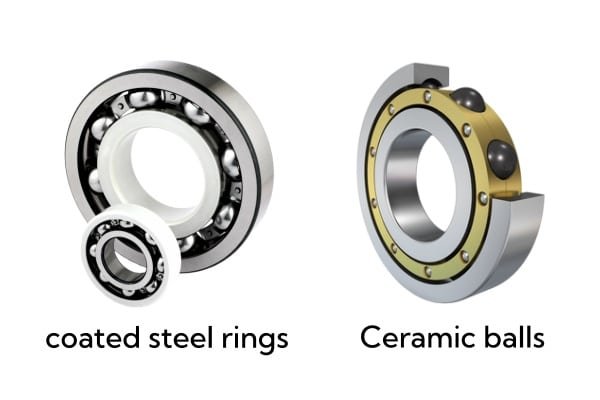
Coated Bearings: A cost-effective solution for standard belt-driven fans or larger direct-drive units (>100 HP). They effectively stop circulating currents.
Hybrid Ceramic Bearings: The preferred choice for high-speed direct-drive fans. Ceramic balls are lighter, reducing centrifugal force and friction heat. They also provide the best electrical isolation for smaller motors prone to EDM.
Fan Configuration Strategy
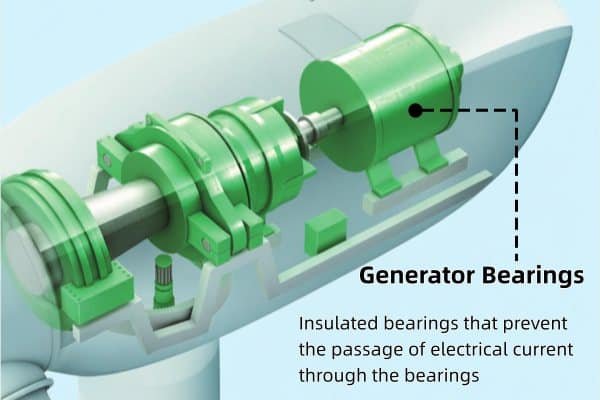
Overhung Fans (Impeller on shaft extension): Standard practice is to install an insulated bearing on the Non-Drive End (NDE) to break the circulating current loop through the frame.
Center-Hung Fans (Impeller between bearings): These large units are prone to high shaft voltages. It is often best to insulate both bearings or use a hybrid bearing on the NDE and a shaft grounding ring on the Drive End.
Installation Best Practices for Fan Reliability
Proper installation prevents new problems from arising.
Critical Fit
Fan bearings require precise housing fits to manage vibration.
Warning: Never force an insulated bearing into a tight housing with a hammer. The ceramic coating is brittle and can crack, destroying the insulation. Use induction heaters for a smooth, slide-on fit.
Grounding the Fan Casing
VFDs aren’t the only source of voltage. The friction of high-velocity air moving over the blades can generate massive static charges (Triboelectric effect). Ensure the fan casing and the motor frame are bonded to a common earth ground to prevent static from discharging back through the motor bearings.
Frequently Asked Questions (FAQ)
Can I retrofit insulated bearings on an existing fan motor?
Yes. Insulated bearings follow standard ISO dimensions. They are a direct drop-in replacement for standard ball or roller bearings in almost all NEMA and IEC motors.
How does bearing insulation affect fan vibration levels?
Initially, it has no effect. However, by preventing electrical erosion, it keeps vibration levels low over time. A standard bearing might see vibration spike after 3 months due to fluting; an insulated bearing maintains “new” vibration levels for years.
Is a shaft grounding ring enough for a 100HP fan motor?
For a 100HP motor, a grounding ring alone might not be enough to stop circulating currents. The best practice is to use an insulated bearing on the Non-Drive End to break the loop, and a grounding ring on the Drive End to bleed residual shaft voltage.
- 图 1:Photo of an induction heater being used to install a bearing (to prevent coating damage).
ALT: Technician using induction heater to install insulated bearing without damage
