

In the vast landscape of industrial machinery, a common question plagues maintenance managers and procurement officers: “Do I really need to pay extra for insulated bearings?” The answer is rarely a simple yes or no. It depends on the motor’s size, its power source, and its application. Making the wrong choice can lead to thousands of dollars in wasted inventory or, worse, catastrophic production downtime due to electrical bearing failure. This guide breaks down the industry standards and “rules of thumb” to help you decide exactly when to specify insulation.
In this decision guide, you will examine:
- The “100 HP Rule” and why motor size matters for electrical protection.
- The critical impact of Variable Frequency Drives (VFDs) on bearing life.
- A clear decision matrix: When to use Grounding Rings vs. Insulated Bearings.
- Why insulating the Non-Drive End (NDE) is the industry standard for large motors.
- NEMA and EASA guidelines for bearing protection.
Let’s turn uncertainty into a clear engineering strategy.
The Core Triggers: Why Do You Need Insulation?
Electrical bearing damage isn’t random; it’s triggered by specific conditions. If your motor fits these criteria, you are at risk.
Trigger #1: Variable Frequency Drives (VFDs)
The single biggest trigger is the VFD. If your motor is line-fed (connected directly to the grid), you generally don’t need insulated bearings unless there’s a specific magnetic asymmetry. However, if a VFD is involved, the high-frequency switching creates Common Mode Voltage.
The Rule: Any VFD-driven motor is a candidate for protection, but the type of protection varies by size.
Trigger #2: Motor Frame Size & Power Rating
According to EASA (Electrical Apparatus Service Association) best practices, motor physical size is a key determinant.
The “100 HP Rule”: For motors larger than 100 HP (75 kW) or frame sizes larger than NEMA 440 / IEC 315, magnetic asymmetries in the large stator create circulating currents. These currents loop through the frame and must be blocked by insulation.
Trigger #3: Medium & High Voltage Applications
Motors operating above 600V (Medium Voltage) often generate higher shaft potentials simply due to the scale of electromagnetic fields involved. Manufacturers like Siemens and ABB typically mandate insulated bearings as a standard feature for these units.
Decision Matrix: Selecting the Right Protection
Use this hierarchy to choose the most cost-effective solution.
Scenario A: Small Motors (<100 HP) on VFDs
Risk: Primarily EDM (Electrical Discharge Machining) sparks.
Verdict: Shaft Grounding Ring (SGR) is usually sufficient.
Reasoning: Circulating currents are rare in small frames. A grounding ring bleeds off the static/EDM voltage cheaply. Insulated bearings are often overkill unless the application is critical (e.g., remote location).
Scenario B: Large Motors (>100 HP) on VFDs
Risk: High-Frequency Circulating Currents AND EDM.
Verdict: Insulated Bearing on NDE (Non-Drive End) is mandatory.
Reasoning: A grounding ring alone cannot stop a circulating current; it just becomes part of the loop. You must use an insulated bearing to cut the circuit.
Scenario C: Critical / High-Voltage Motors
Risk: Severe circulating currents and high shaft potentials.
Verdict: Insulated Bearing on NDE + Grounding Ring on DE.
Reasoning: The “Belt and Suspenders” approach. The NDE bearing stops the loop, and the DE grounding ring bleeds any residual rotor voltage to protect the driven equipment (gearbox/pump).
Insulated Bearing Types: Coated vs. Hybrid for Industry
Once you decide you need insulation, which type do you buy?
When is INSOCOAT (Plasma Coating) Enough?
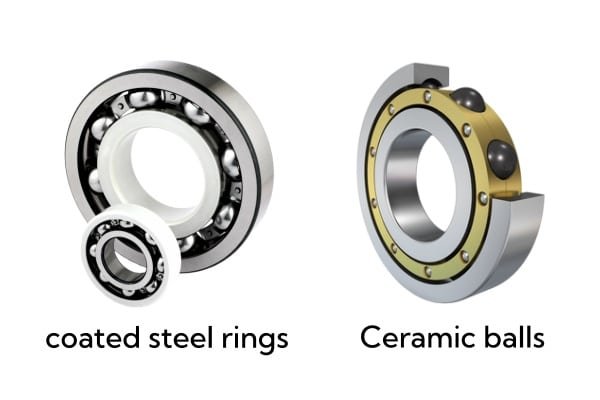
For standard industrial fans, pumps, and conveyors operating at normal speeds, Coated Bearings (aluminum oxide layer) are the industry standard. They offer robust protection at a moderate price point.
When is Hybrid Ceramic Mandatory?
Specify Hybrid Ceramic Bearings if:
- The application is high-speed (risk of coating degradation).
- Lubrication is difficult or infrequent (ceramic lasts longer).
- The drive uses Silicon Carbide (SiC) semiconductors (risk of high-frequency leakage).
Installation Strategy: Which End to Insulate?
Where you put the bearing matters.
The Standard Practice: Non-Drive End (NDE) Only
For stopping circulating currents, you only need to break the loop at one point. The NDE is chosen because it is usually easier to access for maintenance and carries less mechanical load (radial/axial) than the Drive End (DE), reducing stress on the insulation coating.
The Exception: When to Insulate Both Ends
If the driven equipment (like a train wheelset or a conductive fluid pump) is creating its own electrical path, or if the common mode voltage is extremely high, isolating the rotor completely by insulating both ends is the safest bet.
Frequently Asked Questions (FAQ)
Is it worth retrofitting insulated bearings on old motors?
Yes, if the motor is being repaired due to bearing failure. The incremental cost of upgrading to an insulated bearing during a rewind or repair is minimal compared to the cost of another failure.
Can I use insulated bearings on a standard line-fed (non-VFD) motor?
Yes, there is no harm in doing so. It provides future-proofing in case a VFD is added later, though it is technically an unnecessary expense for standard sine-wave operation.
What does NEMA MG1 Part 31 say about bearing insulation?
NEMA standards recommend that for inverter-fed motors, shaft voltages should be kept below a threshold (often 10-20V). If this cannot be achieved by grounding alone, bearing insulation is the recommended mitigation method.
