

In the power generation sector, reliability is the ultimate metric. Whether in a wind turbine nacelle or a thermal power plant, the generator is the revenue-producing heart of the facility. However, a persistent threat known as electrical erosion constantly jeopardizes uptime. Unlike standard motors, generators face unique electrical stresses due to magnetic asymmetries and grid-side harmonics. Implementing generator insulated bearings is a proven strategy to block these destructive currents, prevent shaft damage, and maximize the Mean Time Between Failures (MTBF).
In this power generation guide, you will examine:
- How magnetic asymmetry creates damaging circulating currents in large generators.
- The specific failure modes: Frosting, Pitting, and Babbitt damage in sleeve bearings.
- Why insulating the Non-Drive End (NDE) is the industry standard for breaking current loops.
- The critical role of shaft grounding brushes in conjunction with insulation.
- Special considerations for Wind Turbine Generators (WTG) and high-frequency noise.
Let’s analyze how to fortify your generator against electrical failure.
The Silent Killer: Electrical Issues in Generators
Generators don’t just produce electricity; they can also be destroyed by it internally.
Magnetic Asymmetry: Generators Create Their Own Voltage
Even without a Variable Frequency Drive (VFD), large generators create shaft voltage. Due to manufacturing tolerances, segmentation of stator laminations, or slight air gap variations, the magnetic field is never perfectly symmetrical. This imbalance induces a low-frequency AC voltage along the shaft length, driving a heavy current loop through the frame and bearings.
Stray Currents from Grid Harmonics
Modern power grids are noisy. Harmonics from rectifiers, inverters (in wind/solar), and other non-linear loads can couple back into the generator neutral or frame, creating high-frequency stray currents that seek a path to ground through the bearings.
The Damage Path
In a standard setup, the current flows from the shaft, through the oil film of the Drive End (DE) bearing, through the bedplate, and returns through the Non-Drive End (NDE) bearing. This “circulating current” acts like a welder, pitting both bearings simultaneously.
Diagnosing Generator Bearing Failure
Early detection prevents catastrophic shaft damage.
Recognizing “Frosting” and “Pitting”
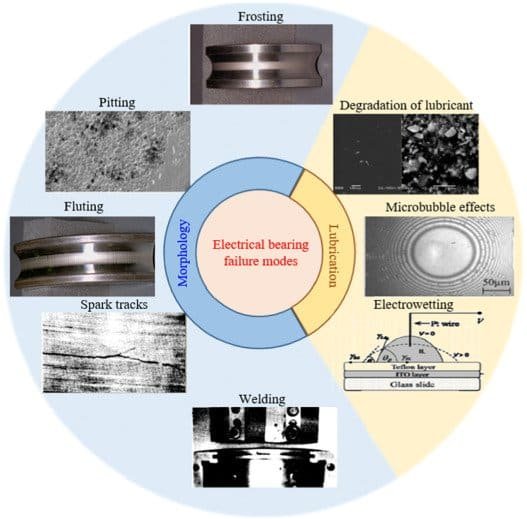
In rolling element bearings, the damage often starts as “frosting”—a dull, gray appearance on the raceways caused by millions of micro-sparks. As it progresses, deep “fluting” marks appear.
In sleeve (journal) bearings, typical in large turbo-generators, the electrical discharge pits the Babbitt material, turning the oil black and potentially scoring the expensive generator shaft journal itself.
Oil Analysis
Routine oil analysis is vital. A sudden spike in carbon content (soot) or the presence of molten metal spheres in the oil sample is a definitive sign that electrical arcing is occurring inside the bearing housing.
The Solution: Insulated Bearings & Protection Strategies
The goal is to interrupt the electrical circuit.
Breaking the Loop: Insulating the Non-Drive End (NDE)
To stop a circulating current, you simply need to break the loop at one point. The industry standard is to install an insulated bearing (or insulated housing) on the Non-Drive End (NDE/Exciter End).
Why NDE? It is typically smaller, carries less mechanical load, and is easier to access for maintenance than the Drive End.
Material Selection
Polymer-Coated Rings: For standard generators, bearings with a plasma-sprayed ceramic or polymer coating on the outer ring provide sufficient resistance.
Glass Fiber Epoxy (GRE): For large sleeve bearings, the entire bearing shell or pedestal is often isolated using high-strength glass fiber reinforced epoxy plates.
The Hybrid Approach: Shaft Grounding Brushes
Insulation blocks the current, but the shaft may still build up a static charge (e.g., from steam flow or wind friction). Therefore, best practice dictates using Insulation on the NDE AND a Shaft Grounding Brush on the DE. The brush bleeds off any residual voltage to the ground, protecting the driven equipment (turbine/gearbox).
Specific Case: Wind Turbine Generators
Wind generators face a double threat.
Handling High-Frequency PWM Spikes
Wind turbines use full-scale power converters that generate high-frequency Common Mode Voltage. This behaves differently than low-frequency asymmetry currents. It can capacitively couple across standard insulation.
Hybrid Ceramic Bearings
For this reason, modern wind generators are shifting to Hybrid Ceramic Bearings. The ceramic rolling elements provide a much higher impedance barrier against high-frequency converter noise than simple coatings, ensuring robustness against both circulating currents and EDM.
Long-Term Benefits (ROI Analysis)
Why invest in premium insulation?
Increasing MTBF
Electrical erosion can destroy a bearing in months. Insulation extends the bearing life to its mechanical fatigue limit (often 10+ years), aligning maintenance intervals with major overhauls.
Preventing Catastrophic Shaft Damage
Replacing a bearing is expensive; machining a scored generator shaft journal is astronomical. Insulation acts as a cheap insurance policy for the most expensive component: the rotor shaft.
Frequently Asked Questions (FAQ)
Should I insulate both bearings on a generator?
Usually, no. Insulating one end (NDE) is sufficient to break the circulating loop. Insulating both ends can leave the rotor electrically “floating,” which might cause dangerous voltage buildup unless a grounding brush is installed.
How do I test the insulation resistance of a generator bearing?
With the machine stopped and any grounding brushes lifted, use a 500V Megohmmeter to measure resistance between the shaft and the ground. A healthy reading should generally be >1 Megaohm (check OEM specs).
What is the acceptable shaft voltage limit for generators?
For plain sleeve bearings, limits are often lower (e.g., <200mV) to prevent pitting. For rolling element bearings, peak voltages should generally stay below 10-20V depending on the grease film.
