
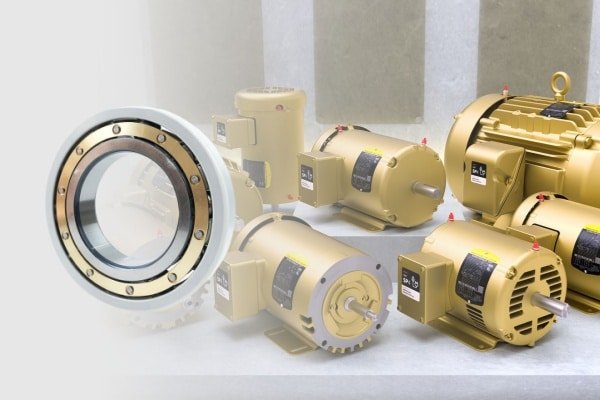

In the realm of high-voltage engineering, insulation is the first line of defense. As industrial motors scale up to Medium Voltage (MV) and High Voltage (HV) classes, the potential for destructive shaft currents increases exponentially. While grounding is essential, the most robust protection often lies within the bearing itself. Ceramic-coated bearings are engineered to provide a high-impedance barrier, preventing electrical discharge from pitting raceways and degrading lubricants. Understanding the dielectric properties and limitations of these coatings is essential for specifying reliable rotating equipment.
In this engineering guide, you will examine:
- The physics of dielectric breakdown and how ceramic coatings prevent it.
- Technical specifications: Breakdown voltage limits (1000V vs. 3000V).
- The critical difference between Inner Ring and Outer Ring coatings.
- The role of resin sealing in preventing moisture-induced insulation failure.
- Handling precautions to avoid cracking the brittle ceramic layer during installation.
Let’s analyze the science behind the coating.
The Challenge: Bearing Survival in High-Voltage Environments
High-voltage environments impose stresses that standard mechanical components are not designed to withstand.
Understanding Dielectric Breakdown
A standard bearing relies on a thin oil film (approx. 1 micron) to separate metal surfaces. This film has a low dielectric strength, typically breaking down at 10-50 Volts. In MV/HV motors, Common Mode Voltages can easily exceed 500V or 1000V. Without additional insulation, the arc simply punches through the oil, causing immediate EDM damage.
Environmental Factors: The Humidity Threat
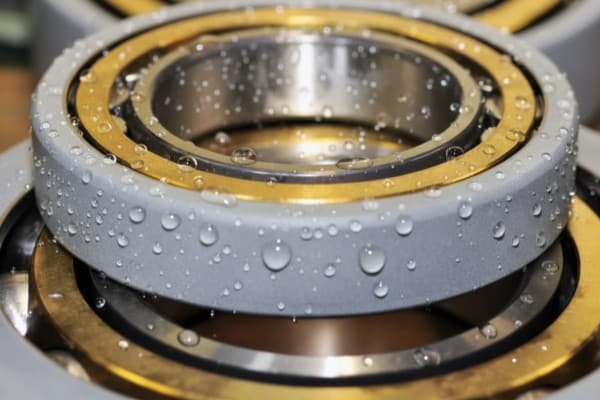
Ceramic materials like Aluminum Oxide are naturally porous. In high-humidity environments (common in power plants or marine applications), moisture can seep into these pores, drastically reducing the insulation resistance. A “dry” bearing might test at 100 MΩ, but a damp one could drop to near zero, rendering the insulation useless.
How Ceramic Coatings Work (The Science)
It’s not just “paint”; it’s a sophisticated plasma-applied ceramic layer.
Plasma Spray Technology
Manufacturers use plasma spraying to deposit a layer of Aluminum Oxide (Al2O3) onto the bearing steel. This creates a hard, wear-resistant, and electrically insulating surface bonded at the molecular level.
Dielectric Strength Specs
The insulation capability depends on coating thickness.
Standard Coating (approx. 100µm): Typically rated for breakdown voltages up to 1,000V DC. Sufficient for most standard VFD applications.
Enhanced Coating (approx. 300µm): Rated for 3,000V DC. Required for Medium Voltage motors or severe electrical environments.
The Importance of Resin Sealing
To combat the porosity issue mentioned above, high-quality coated bearings undergo a vacuum impregnation process. A specialized resin seals the ceramic pores, making the coating impervious to moisture and conductive contaminants.
Selection Guide: Inner Ring vs. Outer Ring Coating
Where should the insulation go? The answer depends on your motor design.
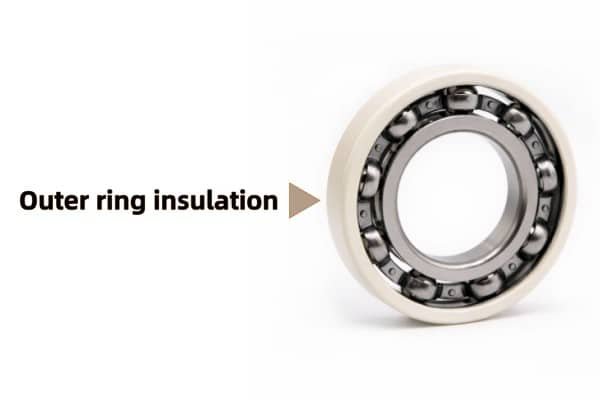
Outer Ring Coating (Standard)
Configuration: The ceramic layer is on the Outer Diameter (OD).
Best For: The vast majority of motors where the housing is stationary and the shaft rotates. It is easier to manufacture and inspect.
Advantage: The coating is protected inside the housing bore.
Inner Ring Coating (Specialized)
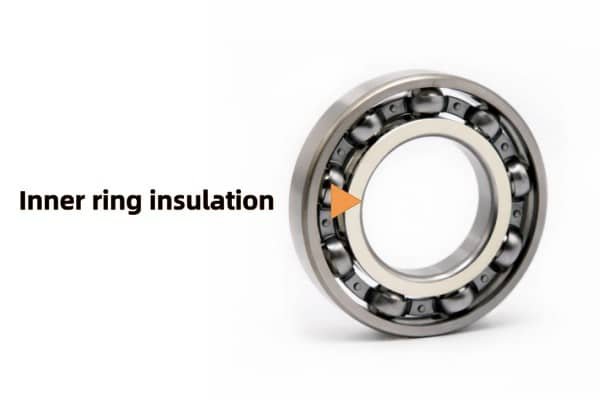
Configuration: The ceramic layer is on the Inner Diameter (ID) bore.
Best For: Applications where the outer ring rotates (e.g., wheel hubs) or where the housing fit is loose, potentially causing wear on an outer coating.
Advantage: Protects against wear in loose housing fits.
Limitations & Handling Risks (Crucial for Engineering)
Ceramic coatings are robust electrically but fragile mechanically.
Mechanical Fragility
Ceramic is brittle. If a technician strikes the coated surface with a hammer during installation, the coating can crack or chip.
The Risk: A crack is a conductive path. Once cracked, the insulation value drops to zero. Always use induction heaters or pressing tools that apply force only to the steel face, never the coated surface.
Thermal Conductivity
Does the coating trap heat? Generally, no. While ceramic is a thermal insulator, the layer is thin enough that it does not significantly impede heat transfer from the bearing to the housing.
Frequently Asked Questions (FAQ)
What is the breakdown voltage of a standard insulated bearing?
Standard ISO-spec insulated bearings (like SKF VL0241 or NSK equivalent) are guaranteed to withstand at least 1,000V DC. Premium versions withstand 3,000V DC.
Can I repair a chipped ceramic coating on a bearing?
No. Once the coating is chipped, the dielectric integrity is compromised. The bearing must be replaced. Do not attempt to “paint over” it with varnish.
How does temperature affect the dielectric strength of the coating?
The dielectric strength of Aluminum Oxide remains stable across standard motor operating temperatures (-40°C to +150°C). However, extreme thermal shock could theoretically cause delamination if the steel expands faster than the ceramic.

2 条评论
Pingback: Coating Adhesion in Insulated Bearings: Durability & Testing Analysis
Pingback: Dielectric Strength in Bearings: The Ultimate Technical Guide