
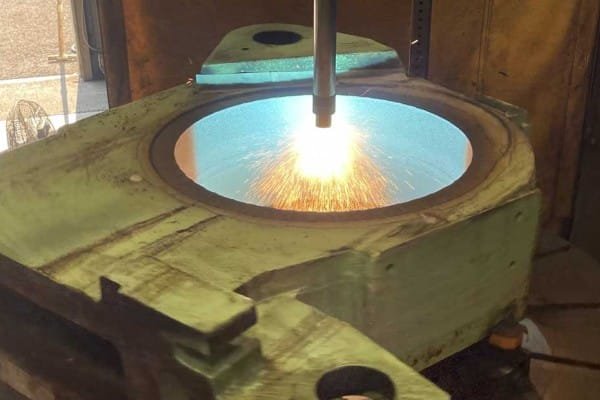

In the battle against electrical erosion, the most effective weapon is often a microscopic layer of ceramic. Plasma spray coating technology allows engineers to bond non-conductive ceramic materials, typically Aluminum Oxide (Al2O3), directly onto the steel surfaces of a bearing. This process transforms a standard steel component into a robust insulated bearing capable of withstanding the high-voltage stresses of modern VFDs. However, the quality of the insulation is entirely dependent on the precision of the manufacturing process. This technical analysis explores the science of Atmospheric Plasma Spray (APS) and the critical steps required to produce a reliable insulated bearing.
In this technical guide, you will examine:
- The physics of melting ceramics at 10,000°C using plasma technology.
- The complete 4-step manufacturing process: Blasting, Spraying, Sealing, and Grinding.
- Why SKF and other OEMs mandate a resin sealing step to prevent moisture ingress.
- Key performance metrics: Dielectric strength vs. coating thickness.
- Typical applications in VFD motors, railways, and wind turbines.
Let’s analyze how extreme heat creates extreme protection.
What is Atmospheric Plasma Spray (APS)?
Atmospheric Plasma Spray (APS) is a thermal spray coating process used to produce high-quality ceramic coatings.
The Physics: Melting Ceramics at 10,000°C+
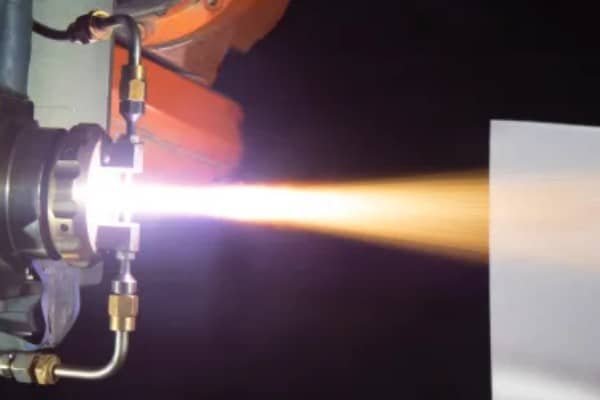
According to surface engineering experts at Oerlikon Metco, the process involves a plasma torch that generates an electrical arc between a cathode and an anode. Inert gas (usually argon or nitrogen) flows through this arc, ionizing into a plasma plume. The core temperature of this plume can exceed 10,000°C (18,000°F). Ceramic powder is injected into this plasma stream, where it instantly melts and is propelled towards the bearing surface at high velocity.
Why Aluminum Oxide (Al2O3) is the Industry Standard
The material of choice for bearing insulation is high-purity Aluminum Oxide. It offers a unique triad of properties:
1. High Electrical Resistance: Excellent dielectric strength.
2. High Hardness: Resistant to wear and scratches during handling.
3. Chemical Stability: Impervious to most industrial oils and solvents.
The 4-Step Manufacturing Process (Core Technical Content)
Applying the coating is not a simple “spray-and-pray” operation. It is a precise multi-stage process.
Step 1: Surface Preparation (Grit Blasting)
Ceramic cannot bond chemically to steel; it relies on a mechanical bond. The bearing ring is first grit-blasted with abrasive media to create a rough surface profile ($Ra$). This roughness increases the surface area and provides “anchors” for the molten ceramic droplets to grip onto.
Step 2: The Spraying Process
The plasma gun traverses the rotating bearing ring, building up the coating layer by layer. The droplets flatten upon impact, solidifying instantly into “splats.”
Thickness Control: The coating is typically applied to a thickness of 100µm to 300µm, depending on the required breakdown voltage rating.
Step 3: Sealing (Impregnation)
This is the most critical yet overlooked step. As noted by NSK, plasma-sprayed coatings are inherently porous (containing 2-5% porosity). If left untreated, moisture from the air would seep into these pores, creating conductive paths and causing insulation failure.
The Fix: The coated ring is vacuum-impregnated with a low-viscosity, non-conductive resin (sealer). This resin penetrates deep into the pores, curing to form a watertight, airtight barrier.
Step 4: Precision Grinding
The as-sprayed surface is rough (like sandpaper) and dimensionally oversized. The final step is precision grinding the coated surface back to standard ISO bearing tolerances, ensuring a perfect fit into the motor housing.
Key Performance Characteristics
How do we measure the quality of the coating?
Dielectric Strength
The primary metric is Breakdown Voltage ($V_{DC}$).
Standard Layer (~100µm): Provides protection >1,000V DC.
Enhanced Layer (~300µm): Provides protection >3,000V DC.
See Curtiss-Wright regarding porosity impact on dielectric strength.
Bond Strength
The adhesion of the coating to the substrate is tested per ISO 14923 or ASTM C633 standards. A high bond strength (>40 MPa) ensures the coating does not delaminate under thermal cycling or press-fit stresses.
Thermal Conductivity & Dissipation
Does the coating trap heat? While Aluminum Oxide is a thermal insulator compared to steel, the layer is so thin that its impact on the overall heat dissipation of the bearing is negligible.
Applications: When to Use Plasma Sprayed Bearings?
This technology is the go-to solution for:
- Variable Frequency Drive (VFD) Motors: To block high-frequency common mode voltages.
- Traction Motors: Railway motors use heavy-duty coated bearings to withstand high dV/dt from traction inverters.
- Wind Turbine Generators: To prevent circulating currents in large MW-class generators.
Frequently Asked Questions (FAQ)
Why is sealing necessary for plasma-sprayed coatings?
Without sealing, the natural porosity of the ceramic would absorb humidity, causing the insulation resistance to drop drastically in damp environments, leading to electrical failure.
Can plasma spray coatings be applied to the inner ring?
Yes. While outer ring coating is more common, inner ring coating is used when the outer ring rotates or for specific housing fit requirements. The process remains the same.
What is the difference between plasma spray and PTFE coatings?
Plasma sprayed Aluminum Oxide is hard, ceramic, and electrically insulating. PTFE (Teflon) coatings are soft, polymer-based, and typically used for lubrication or corrosion resistance, not for high-voltage electrical insulation.
