
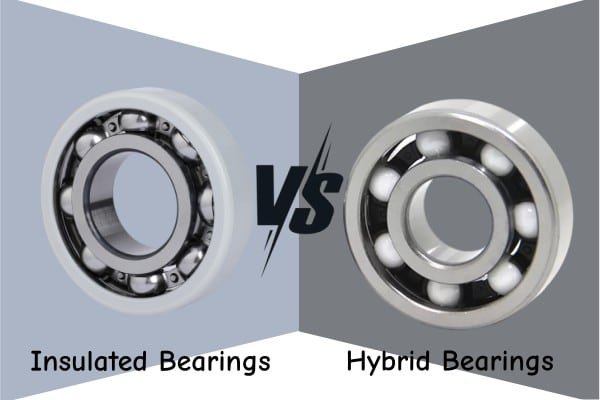

When protecting electric motors from stray currents, engineers face a classic dilemma: Hybrid Bearings vs. Insulated (Coated) Bearings. Both solutions aim to stop Electrical Discharge Machining (EDM) damage, but they achieve it through fundamentally different physics. One relies on a surface coating, while the other changes the material of the rolling element itself. Choosing the wrong one can lead to unnecessary costs or continued failure. This guide pits these two technologies against each other to help you decide which is best for your application.
In this comparison guide, you will examine:
- The structural difference between Coated Rings and Ceramic Rolling Elements.
- Why Hybrid Bearings outperform coatings in high-frequency applications.
- Mechanical advantages of ceramic balls: Higher speeds and cooler running.
- Cost analysis: Where coated bearings offer unbeatable ROI.
- A final decision matrix for VFD motors, generators, and spindles.
Let’s start the head-to-head battle.
Definitions: What’s Under the Hood?
First, let’s clarify the terminology.
Insulated Bearings (Coated)
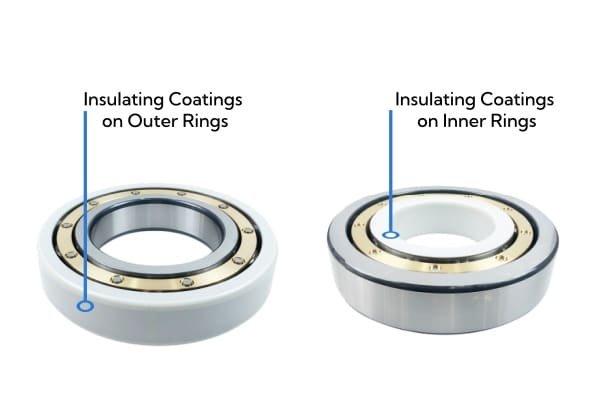
Also known by trade names like INSOCOAT, these are standard steel bearings (steel rings and steel balls) that have a thin layer of non-conductive ceramic (aluminum oxide) plasma-sprayed onto the outer or inner ring.
Strategy: They build a “wall” on the surface to block current.
Hybrid Bearings
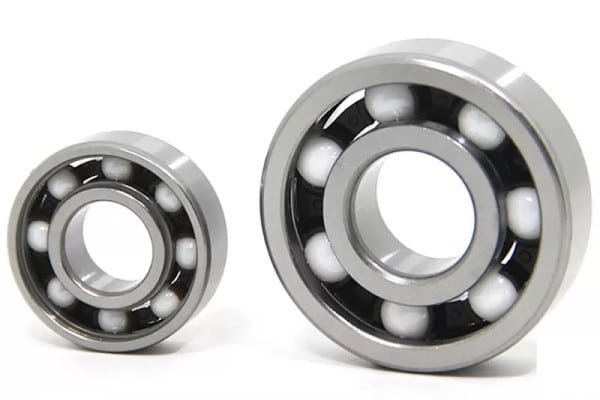
These bearings feature standard steel rings but replace the steel rolling elements with Silicon Nitride (Si3N4) ceramic balls or rollers.
Strategy: They remove the conductive path entirely by using a non-conductive rolling element.
Round 1: Electrical Performance (The Core Battle)
Which one stops electricity better?
Impedance and Capacitance
Insulated Bearings: The thin coating acts as a dielectric in a capacitor. At DC or low frequencies, it is an excellent insulator. However, at very high switching frequencies (like in SiC drives), capacitive coupling can allow some current to leak through the coating.
Hybrid Bearings: The solid ceramic ball is a thick insulator with extremely low capacitance. According to NKE Austria, hybrid bearings offer virtually infinite DC resistance and far superior impedance against high-frequency currents compared to coatings.
Durability of Insulation
Insulated Bearings: The coating is brittle. Rough handling during installation can chip the coating, destroying the insulation.
Hybrid Bearings: The insulation is intrinsic to the ball material. It cannot be “chipped off” or scratched away.
Round 2: Mechanical Performance & Lubrication
This is where Hybrid bearings truly shine.
Speed Capabilities
Ceramic balls are 40% lighter than steel balls. This significantly reduces centrifugal force and gyroscopic spinning, allowing Hybrid bearings to operate at speeds 20-40% higher than steel/coated bearings without overheating.
Lubrication Life
Hybrid bearings run cooler due to lower friction. For every 10°C drop in operating temperature, grease life doubles. Additionally, ceramic does not “cold weld” to steel, meaning hybrid bearings survive marginal lubrication conditions far better than all-steel designs.
Static Vibration (False Brinelling)
When a standby motor vibrates without rotating, steel balls can hammer dents into the raceway (False Brinelling). Ceramic balls are lighter and dissimilar to the steel ring, making them immune to adhesive wear in these static conditions.
Round 3: Cost and ROI Analysis
Here is where Coated bearings strike back.
Upfront Cost
Insulated Bearings: For medium to large motors (>100mm bore), coated bearings are significantly cheaper (often 30-50% less) than hybrid equivalents. The cost of a few grams of oxide powder is negligible compared to precision-machined ceramic spheres.
Hybrid Bearings: Manufacturing flawless silicon nitride balls is expensive. The price premium is high, especially for larger sizes.
The Verdict: When to Choose Which? (Decision Matrix)
Use this logic to make your purchase.
Choose Insulated Bearings (Coated) IF:
- Application: Standard Industrial Motors (>100 HP), Pumps, Fans.
- Drive Type: Standard IGBT VFDs.
- Goal: Preventing Circulating Currents and EDM at a reasonable cost.
Choose Hybrid Bearings IF:
- Application: High-Speed Spindles, Traction Motors, EV Motors.
- Drive Type: High-Frequency SiC/GaN Drives.
- Condition: Poor lubrication, extreme temperatures, or standby vibration risks.
- Goal: Maximum reliability and service life regardless of cost.
Frequently Asked Questions (FAQ)
Can I mix hybrid and steel bearings in the same motor?
Technically yes, but it is uncommon. Usually, you might put a Hybrid bearing on the Non-Drive End (to handle poor lubrication or insulation) and a standard steel bearing on the Drive End, provided the DE is grounded with a ring.
Do hybrid bearings require special grease?
No. They use standard bearing greases. In fact, because they run cooler and cleaner, standard grease lasts significantly longer in a hybrid bearing.
Is the load rating of hybrid bearings lower than steel?
Slightly, in terms of static load rating ($C_0$), because ceramic is harder and doesn’t deform like steel (lower elasticity). However, for most dynamic motor applications, the load capacity is sufficient and often exceeds the actual application needs.
