
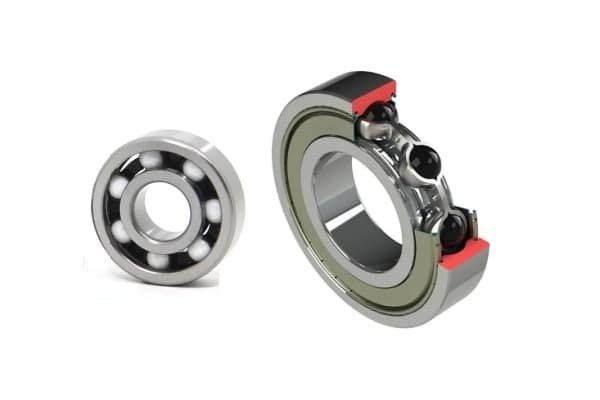

In the world of industrial bearings, hybrid technology—combining steel rings with ceramic rolling elements—represents the pinnacle of performance. While often marketed simply as “insulated bearings” for VFD motors, the advantages of ceramic balls extend far beyond electrical resistance. From reducing centrifugal force at high speeds to extending grease life in harsh environments, the material properties of Silicon Nitride (Si3N4) are rewriting the rules of tribology. This guide explores why ceramic balls are considered the ultimate upgrade for modern rotating machinery.
1. The Material Science: Why Silicon Nitride?
Not all ceramics are created equal. Bearing-grade Silicon Nitride is an advanced engineering ceramic engineered for extreme toughness.
Density & Weight: The Lightweight Champion
Silicon Nitride has a density of approximately 3.2 g/cm³, compared to 7.8 g/cm³ for bearing steel.
The Physics: This 60% reduction in mass means significantly lower inertia. In applications requiring rapid starts and stops (like servo motors), ceramic balls respond faster with less energy consumption.
Hardness & Stiffness
Hardness: Ceramic balls rate roughly 78 HRC (Rockwell C scale), compared to 60 HRC for standard steel. This makes them virtually immune to surface scratches and wear from contaminants.
Stiffness: With a Modulus of Elasticity 50% higher than steel, ceramic balls deform less under load. This rigidity improves the precision and accuracy of high-speed spindles.
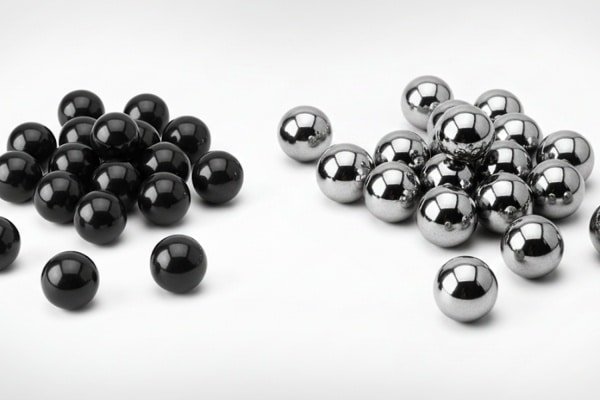
Surface Finish: The “Perfect” Sphere
Due to their extreme hardness, ceramic balls can be polished to a surface finish (Ra) far smoother than steel. According to Saint-Gobain, this superior finish reduces rolling friction, leading to significant energy savings.
2. Electrical Benefits: The Ultimate Insulator
This is the most common reason for their adoption in electric motors.
Impedance Properties
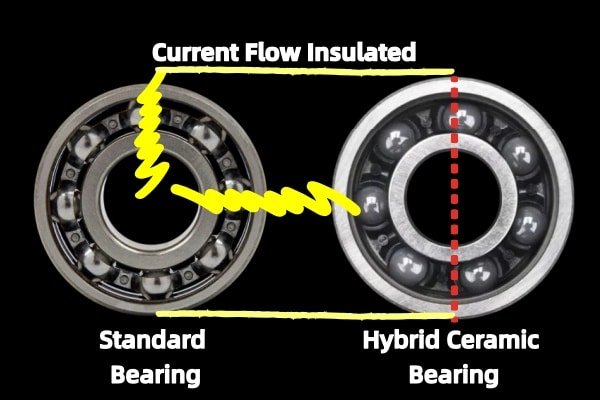
Silicon Nitride is a superb electrical insulator. Unlike coated bearings, which act as capacitors and can leak high-frequency currents, a solid ceramic ball provides infinite DC resistance and negligible capacitance. This makes Hybrid Bearings the only fail-safe solution for motors driven by fast-switching Silicon Carbide (SiC) inverters.
Eliminating Micro-Welding
Since ceramic is non-conductive, electrical arcs cannot pass through the rolling contact zone. This eliminates the risk of micro-welding and pitting, protecting the raceway from the “washboard” fluting patterns that destroy standard VFD motors.
3. Mechanical Benefits: Speed, Heat, and Vibration
Beyond insulation, the mechanical perks justify the cost in high-performance applications.
Reducing Centrifugal Force: The Key to High Speed
Mechanism: As a bearing spins, the balls are pushed outward against the outer raceway by centrifugal force. Since force equals mass times acceleration ($F=ma$), the lighter ceramic balls exert less outward force.
Result: Reduced friction and heat generation at the outer race contact. This allows hybrid bearings to operate at speeds 20% to 40% higher than equivalent steel bearings.
Lubrication Efficiency: Surviving “Starvation”
Tribology: Ceramic and steel are dissimilar materials, meaning they have no affinity to “cold weld” or seize together. Hybrid bearings can operate successfully with very thin lubricant films (low Kappa values) where all-steel bearings would fail due to adhesive wear.
Grease Life: Because hybrid bearings generate less internal heat, the grease oxidizes more slowly. SKF data suggests grease life can be extended by 2 to 4 times.
Resistance to False Brinelling
Problem: When a standby motor sits idle on a vibrating platform, heavy steel balls hammer into the raceway, creating dents (False Brinelling).
Solution: The lower mass of ceramic balls reduces this impact force, and their non-reactive nature prevents the fretting corrosion often associated with static vibration.
4. The “Healing Effect” on Raceways
A unique, lesser-known benefit is the polishing action.
Because ceramic balls are so much harder than the steel rings, they can actually smooth over minor surface imperfections or dents in the steel raceway during operation. This continuous “polishing effect” prevents small defects from growing into large spalls, effectively extending the service life of the steel rings.
5. Applications: Where is the ROI Highest?
- Electric Vehicle (EV) Traction Motors: Essential for handling 20,000 RPM speeds and 800V bus voltages.
- Wind Turbine Generators: Crucial for preventing electrical erosion in offshore towers where maintenance is exorbitantly expensive.
- High-Speed Spindles (CNC): Where stiffness and low thermal expansion ensure micron-level machining precision.
- Chemical & Process Pumps: For reliability in corrosive environments or where process fluids (like refrigerants) provide poor lubrication.
Comparative Analysis: Ceramic vs. Steel Balls
| Property | Steel (52100) | Ceramic ($Si_3N_4$) | Benefit of Ceramic |
|---|---|---|---|
| Density (g/cm^3) | 7.8 | 3.2 | Lower centrifugal force, Higher speed |
| Hardness (HRC) | 60 | 78 | Wear resistance, Polishing effect |
| Expansion Coeff. (10^{-6}/K) | 12 | 3 | Thermal stability |
| Electrical Resistivity | Conductor | Insulator | No electrical erosion |
Frequently Asked Questions (FAQ)
Are ceramic balls brittle? Will they shatter?
While ceramic is technically brittle compared to steel, Bearing Grade Silicon Nitride is engineered for extreme toughness. In a properly sized bearing, the balls will not shatter under normal or even heavy loads. They are far more robust than household ceramics.
Can I replace steel balls with ceramic ones in a standard bearing?
Technically yes, but it is risky. Hybrid bearings use specific internal clearances (C3, C4) to account for the different thermal expansion rates. Simply swapping balls in a standard clearance bearing could lead to seizing as the steel rings expand faster than the ceramic balls.
Why are hybrid bearings so expensive?
The manufacturing process for defect-free silicon nitride balls involves sintering at extreme temperatures and pressures (HIP process), followed by diamond grinding that can take weeks. This complex processing drives the cost.
