
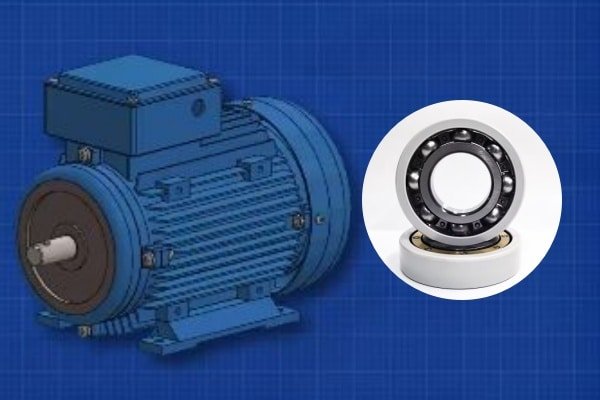

When engineering a reliable VFD motor or generator, the Breakdown Voltage of the bearing insulation is the critical safety margin. It represents the absolute ceiling of protection—the voltage level at which the insulating barrier fails, allowing destructive current to arc through the bearing. While manufacturers like SKF publish standard values (e.g., 1000V DC), these numbers are derived from controlled lab conditions. In the real world, seven key variables determine the actual point of failure. This technical analysis explores the physics of dielectric breakdown and the factors that degrade insulation performance.
Defining Breakdown Voltage: The Theoretical Limit
Breakdown voltage is not an arbitrary number; it is the result of material physics.
Breakdown Voltage vs. Dielectric Strength
While related, they are distinct concepts.
Dielectric Strength: An intrinsic property of the ceramic material (Aluminum Oxide), typically ~15 kV/mm.
Breakdown Voltage: The property of the finished component. It is calculated as:
V_bd = E_ds × d
where d is the insulation thickness. This linear relationship is the baseline, but real-world factors cause deviations.
The Physics of Failure: Electron Avalanche
Electrical breakdown occurs via an “Electron Avalanche” mechanism. When a strong electric field is applied, free electrons accelerate and collide with atoms in the ceramic lattice, knocking loose more electrons. As voltage increases, this chain reaction becomes self-sustaining, creating a conductive plasma channel (an arc) through the solid material.
Factor #1: Insulation Thickness (The Primary Variable)
The most direct way to increase voltage tolerance is to add material.
The Linear Relationship
Generally, thickness correlates with protection:
• 100µm (Standard): Provides ~1000V DC breakdown.
• 300µm (Enhanced): Provides ~3000V DC breakdown.
However, there are diminishing returns. As thickness increases beyond 500µm, the risk of internal structural defects (cracks/voids) rises, which can locally reduce the effective breakdown voltage.
Factor #2: Porosity and Sealing (The Hidden Variable)
A ceramic coating is not a solid slab; it is a stack of melted particles.
Plasma Spray Porosity
Thermal spray coatings naturally contain 5-10% porosity. Since air has a low dielectric strength (~3 kV/mm) compared to ceramic (~15 kV/mm), unsealed pores are the “weakest link” where breakdown will initiate.
The Role of Resin Impregnation
To fix this, manufacturers use vacuum impregnation with resins (Epoxy or Phenolic). As detailed by Elantas, filling the voids with a high-dielectric resin (20 kV/mm) restores the overall breakdown voltage of the layer.
Factor #3: Environmental Conditions (Humidity & Temperature)
The environment attacks the insulation’s weaknesses.
The Moisture Effect (Hygroscopicity)
According to NKE Austria, humidity is the enemy. Even sealed coatings can have surface micropores. Water molecules absorbed into the surface lower the surface resistivity, allowing voltage to “creep” across the surface (flashover) at much lower voltages than required to punch through the material.
Thermal Degradation (Thermal Runaway)
As temperature rises, the insulating resin may soften or degrade, and the ceramic lattice vibrates more, increasing ionic conductivity. This leads to “Thermal Breakdown,” where leakage current generates heat, which lowers resistance further, leading to a runaway failure.
Factor #4: Voltage Type (DC vs. AC vs. PWM)
Not all Volts are equal.
DC vs. AC Breakdown
Insulation typically withstands higher DC voltages than AC. Under AC stress, dielectric losses generate internal heat, lowering the breakdown threshold.
PWM dV/dt Stress
In VFD applications, the voltage is not a smooth sine wave but a series of high-frequency pulses (PWM). The rapid voltage rise time (High dV/dt) causes “Partial Discharge” (PD) within microscopic voids. These PD events erode the insulation from the inside out, lowering the breakdown voltage over time.
Factors #5-7: Manufacturing & Operational Variables
5. Surface Cleanliness: Conductive contaminants (carbon dust, metal shavings) on the bearing surface can bridge the insulation gap, effectively reducing the breakdown voltage to zero.
6. Mechanical Stress: Press-fitting a bearing puts the coating under hoop stress. Excessive interference fits can cause micro-cracks, which become easy paths for voltage breakdown.
7. Aging: Over years of thermal cycling, the interface between the steel and ceramic weakens, potentially leading to delamination voids where arcing can occur.
7. Measurement & Testing Standards
Verification is key.
Non-Destructive Proof Test
This is the standard QC test (e.g., ISO 2041). A voltage (e.g., 500V DC) is applied to verify resistance is >50 MΩ. It proves the insulation is functional but does not find the upper limit.
Destructive Breakdown Test
To find the true $V_{bd}$, voltage is ramped up until an arc occurs. This destroys the component but is necessary for R&D qualification of new coating materials.
Frequently Asked Questions (FAQ)
Does breakdown voltage decrease over time?
Yes. Due to thermal aging of the sealing resin and cumulative stress from Partial Discharge (in VFDs), the breakdown threshold will gradually lower over the bearing’s service life.
Can I test breakdown voltage with a standard multimeter?
No. Multimeters use low voltage (9V). You need a Hipot Tester (High Potential) or Megohmmeter capable of generating kilovolts to test breakdown limits.
What happens if the insulation breaks down once?
Breakdown is usually permanent. The high-energy arc carbonizes the sealing resin and melts a channel through the ceramic, creating a permanent conductive path. The bearing is no longer insulated.
