


For any insulated bearing—whether coated with aluminum oxide or using hybrid ceramic technology—verification is vital. Before installing an expensive insulated bearing into a VFD motor or generator, you must confirm that the insulation layer is intact. A cracked coating or moisture contamination can render the insulation useless, leading to immediate electrical damage upon startup. This guide details the industry-standard procedure for performing an Insulation Resistance (IR) test, often called a “Megger test,” to ensure your bearings meet the required specifications.
In this testing guide, you will examine:
- The global acceptance criteria for insulation resistance (>50 MΩ).
- Why standard multimeters fail to detect insulation faults.
- A step-by-step procedure for probe placement and voltage application.
- How humidity and surface contamination can cause false failures.
- Safety protocols for handling high-voltage DC testing equipment.
Let’s validate your protection before you power up.
Why Test Insulation Resistance? (The Basics)
Insulated bearings are robust but not invincible. Shipping damage, improper handling (dropping), or manufacturing defects can compromise the ceramic layer. Testing confirms two things:
1. Integrity: The ceramic layer is continuous and free of cracks.
2. Cleanliness: The surface is free of conductive contaminants (water, metal dust) that could bridge the insulation.
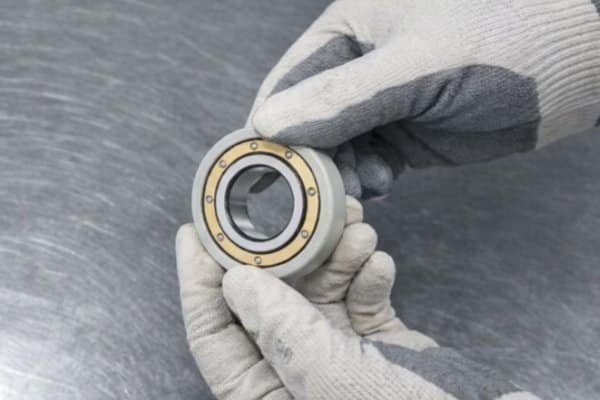
Acceptance Criteria: What is a “Good” Reading?
According to major manufacturers like SKF, NSK, and NKE, the criteria are specific.
The Gold Standard: >50 MΩ @ 500V DC
For a new insulated bearing, the resistance measured between the inner and outer rings should be greater than 50 Megaohms (50 MΩ).
Note: Premium coatings or hybrid bearings often read “Infinity” or >100 MΩ. Any reading below 1 MΩ indicates a failed or bridged insulation layer.
Voltage Settings
You must perform the test at 500V DC (or up to 1000V DC for high-voltage specs).
Warning: Do not use a standard digital multimeter. A multimeter typically uses only 9V for resistance testing, which is insufficient to stress the insulation or detect microscopic tracking paths. You must use an Insulation Tester (Megohmmeter).
Tools Required: Megger vs. Multimeter
To perform this test, you need:
- Insulation Resistance Tester (Megger): Capable of generating 500V/1000V DC.
- Insulated Alligator Clips: To ensure solid contact without touching the metal.
- Cleaning Solvent & Rag: To clean the bearing surfaces before testing.
Step-by-Step Testing Procedure
Follow this protocol to avoid false readings.
Step 1: Preparation
Place the bearing on a clean, non-conductive surface (like a rubber mat or wood bench). Crucial: Wipe the insulated surfaces (outer ring OD and side faces) with a solvent to remove any preservative oil, moisture, or fingerprints. Oil and sweat are conductive and can cause a “Fail” reading on a good bearing.
Step 2: Probe Placement
Connect your Megger leads:
Negative Lead (Black): Connect to the uninsulated Inner Ring (or the steel raceway).
Positive Lead (Red): Connect to the conductive steel surface of the Outer Ring.
Note: If testing an Outer Ring coated bearing, you need to probe through the coating? No. Probe the steel FACE of the ring if it’s uncoated, or use a specific conductive band if the entire ring is coated. Wait—standard testing measures current flowing THROUGH the coating. So, one probe goes on the Inner Ring, and the other must contact the Outer Ring’s conductive surface (often the raceway or an uncoated side face). Alternatively, for installed bearings, measure between the shaft and the housing.
Correction for Bench Test: One probe on the Inner Ring bore. The other probe on the Outer Ring OD (on top of the ceramic coating). Wait—this measures surface resistance. The correct Bench Test measures Through-Resistance: One probe on the Inner Ring, one probe on the Metal Foil wrapped tightly around the coated Outer Ring (simulating a housing). This ensures you measure the coating’s ability to stop current.
Step 3: Running the Test
Set the Megger to 500V. Press and hold the “Test” button. The reading will fluctuate initially as the capacitance charges. Wait 60 seconds for the reading to stabilize. Record the value.
Factors Affecting Test Results (Troubleshooting)
Did you get a low reading? Don’t scrap the bearing yet.
Humidity and Moisture
Ceramic coatings can be porous. High humidity can create a microscopic layer of water on the surface, allowing current to “creep” around the insulation.
Fix: Clean the bearing thoroughly with alcohol and dry it in a warm oven (approx. 50°C) for 1 hour. Retest. Often, the reading will jump back to infinity.
Conductive Contamination
Metal dust from a workshop or graphite from a pencil mark can bridge the insulation. Ensure the testing area is surgically clean.
Frequently Asked Questions (FAQ)
Can I test insulation resistance on a mounted bearing?
Yes. If the bearing is installed in a motor, lift the brushes (if any) and disconnect the ground wire. Measure resistance between the motor shaft and the motor frame. This tests the entire insulation system (bearing + grease + housing interface).
Does the Ohmic value change with temperature?
Yes. Insulation resistance decreases as temperature increases. However, for ceramic coatings, this effect is minimal compared to winding insulation. The >50 MΩ limit applies at room temperature (20°C).
What if the reading is 0 MΩ (Short Circuit)?
The insulation has completely failed (cracked coating) or there is a direct metal-to-metal bridge (e.g., a burr in the housing or a metal chip stuck in the coating). The bearing must be replaced.
