

In the realm of industrial rotating machinery, premature bearing failure remains a costly disruption to production. Among the various failure modes, bearing fluting stands out due to its distinct visual pattern and its direct correlation with modern Variable Frequency Drive (VFD) technology. Unlike mechanical wear, fluting is a symptom of electrical issues within the motor system. Understanding the specific mechanism behind this damage is essential for reliability engineers and maintenance personnel aiming to extend motor life and reduce unplanned downtime.
In this technical guide, you will examine:
- The definition of bearing fluting and how to identify the “washboard” pattern.
- The critical role Variable Frequency Drives (VFDs) play in generating damaging currents.
- How to distinguish between electrical fluting and mechanical false brinelling.
- The physics behind electrical discharge machining (EDM) in bearings.
- Actionable solutions, including grounding rings and insulated bearings.
- Answers to frequently asked questions regarding warranty and repair.
Let’s begin by defining what this specific damage looks like and distinguishing the signs from other bearing defects.
What Is Bearing Fluting? (Definition & Identification)
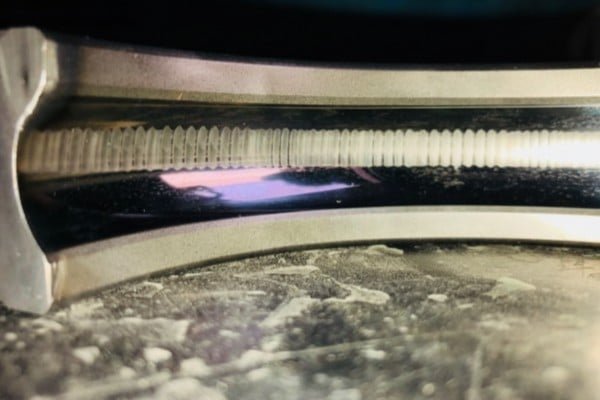
Bearing fluting is a specific pattern of damage on the raceways of ball or roller bearings, characterized by a series of parallel grooves. It is the advanced stage of electrical erosion caused by the continuous passage of electrical current through the bearing.
Visual Characteristics: The “Washboard” or “Tiger Stripe” Pattern
The most reliable visual indicator of fluting is the appearance of closely spaced, rhythmic grooves across the bearing race. Industry professionals often describe this as a “washboard” or “tiger stripe” pattern. These grooves are typically uniform in depth and spacing. They are formed as the rolling elements vibrate in the initial micro-craters caused by electrical pitting, eventually resonating to carve deep lines into the steel.
Auditory Signs: The High-Pitched Whine
Before the damage becomes catastrophic, fluting often announces itself through sound. As the rolling elements travel over the corrugated raceway, they generate a distinct, loud, high-pitched whine or screech. This noise is often directly proportional to the motor speed and can be distinguished from the lower-frequency rumble of general mechanical looseness.
Where It Typically Occurs
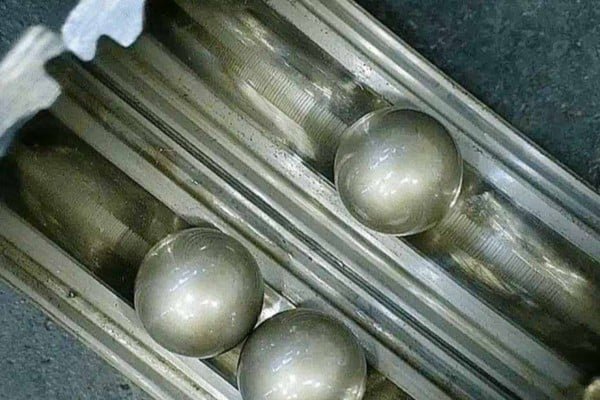
Fluting is most commonly found on the load zone of the outer race, as this is where the electrical arc gap is smallest and most consistent. However, in severe cases, the damage will transfer to the inner race and the rolling elements (balls or rollers) themselves, which may appear frosted or dull gray.
The Root Causes of Bearing Fluting
While mechanical resonance shapes the grooves, the root cause of the material removal is purely electrical.
Primary Cause: Electrical Discharge Machining (EDM)
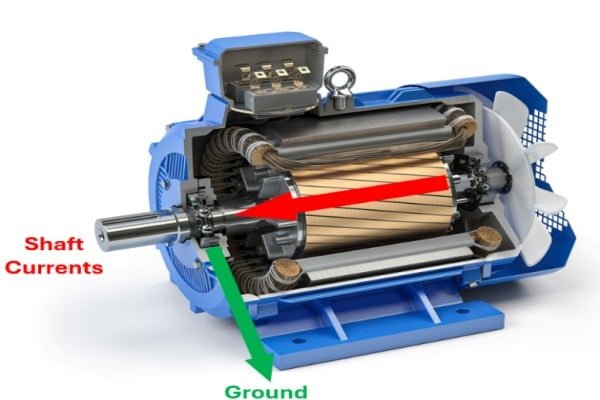
The fundamental cause of fluting is Electrical Discharge Machining (EDM). Stray voltage on the motor shaft builds up until it exceeds the dielectric strength of the bearing grease. Once this threshold is crossed, the energy discharges (arcs) through the bearing to the ground. This arc reaches temperatures high enough to melt a microscopic pit in the steel.
The Role of VFDs (Variable Frequency Drives)
The proliferation of fluting issues is directly tied to the use of VFDs. VFDs utilize Pulse Width Modulation (PWM) to control motor speed. The high-speed switching of the drive’s insulated gate bipolar transistors (IGBTs) generates high-frequency, common-mode voltages. Because of parasitic capacitance, these voltages couple to the motor shaft and seek the path of least resistance to the ground—often through the bearings.
Poor Grounding and Cabling Practices
Even with a VFD, fluting can be mitigated if the system is grounded correctly. However, high-impedance ground paths or the use of unshielded motor cables can exacerbate the issue. Without a low-impedance path back to the drive, the high-frequency currents are forced to travel through the motor bearings to the building ground.
Bearing Lubrication Failure
As the electrical arcing degrades the grease (turning it black and burnt), the lubricant loses its ability to maintain a film between the metal surfaces. This breakdown accelerates the damage, allowing for more frequent and intense arcing.
Critical Diagnosis: Bearing Fluting vs. False Brinelling
One of the most common diagnostic errors in the field is confusing electrical fluting with false brinelling. While they look similar at a glance, their root causes and solutions are entirely different.
Visual Differences: Shiny vs. Dull
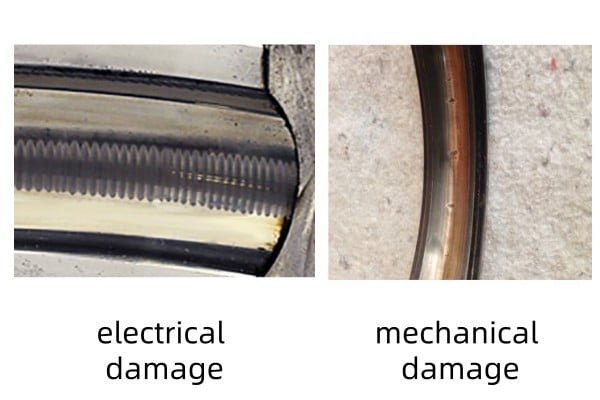
Fluting (Electrical): The bottom of the grooves in fluting is typically shiny or melted in appearance due to the intense heat of the electrical arc. The pattern is often very consistent and rhythmic across a large portion of the race.
False Brinelling (Mechanical): This damage is caused by vibration when the bearing is static (not rotating). The grooves are wear marks caused by abrasion. They often appear dull and may have a reddish or orange tint due to fretting corrosion (iron oxide formation), which is absent in electrical fluting.
Cause Differences
Fluting requires the motor to be rotating for the rhythmic pattern to form via arcing. False Brinelling occurs when a stopped motor is subjected to external vibrations (e.g., from nearby machinery or during transport), causing the balls to rub against the race in one spot.
The Physics: How Does Current Cut Steel?
Understanding the physics helps explain why the damage is so destructive.
The Cycle of Accumulation and Breakdown
Think of the motor as a capacitor. The rotor and stator are the plates, and the air gap is the insulator. As the VFD operates, voltage potential accumulates on the rotor. The bearing grease acts as a secondary insulator. When the shaft voltage exceeds the grease’s breakdown voltage (often 10-30 volts), the insulation fails instantly.
Heat Generation
When the arc jumps across the lubrication gap, the current density is incredibly high. This instantaneous discharge vaporizes the grease and melts the steel at the contact point. This process happens thousands of times per second, removing material bit by bit until the “washboard” texture is established.
How to Prevent Bearing Fluting (Actionable Solutions)
Once fluting has occurred, the bearing cannot be repaired; it must be replaced. Therefore, prevention is the only viable strategy.
Isolating the Source: Using Insulated Bearings
Insulated bearings, such as hybrid ceramic bearings or bearings with aluminum oxide coatings, stop the current flow. By using non-conductive rolling elements or rings, the electrical circuit through the bearing is broken, preventing arcing entirely.
Diverting the Current: Shaft Grounding Rings (SGR)
Shaft Grounding Rings (SGR) are one of the most effective solutions for VFD-driven motors. These rings use conductive micro-fibers to create a low-resistance contact between the rotating shaft and the motor frame. This allows the voltage to bleed off safely to the ground, bypassing the bearings.
Improving VFD Cabling
Replacing standard wiring with symmetric, shielded VFD cables helps contain electromagnetic interference (EMI) and provides a dedicated, low-impedance path for high-frequency noise to return to the drive source rather than traveling through the motor.
Frequently Asked Questions (FAQ)
Can bearing fluting be repaired?
No. The material removal caused by electrical erosion is permanent. Polishing the raceway will not restore the geometry or the surface hardness. The bearing must be replaced, and mitigation strategies (like grounding rings) must be installed to prevent recurrence.
How fast can fluting destroy a bearing?
The timeline varies based on voltage magnitude and switching frequency. In severe VFD applications without protection, audible fluting can develop in as little as a few weeks or months after installation.
Why does fluting sound like a loud whistle?
The “whistle” or “screech” is caused by the rolling elements impacting the ridges of the washboard pattern at high speed. The frequency of the sound corresponds to the number of flutes passing the rolling elements per second.
Is fluting covered by bearing warranty?
Generally, no. Bearing manufacturers typically classify fluting as an external system failure (improper grounding or VFD issues) rather than a defect in bearing materials or workmanship.
