
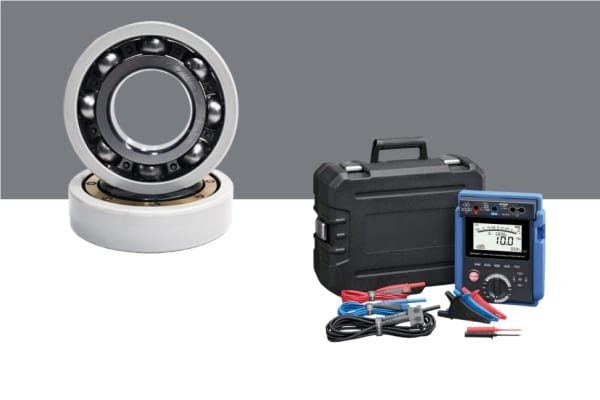

In the world of electric motor reliability, mechanical specs like load rating and speed limit are no longer enough. With the ubiquity of Variable Frequency Drives (VFDs), the electrical properties of the bearing have become equally critical. The most important of these electrical specifications is Dielectric Strength. But what exactly does this term mean in the context of a bearing? Is it the same as breakdown voltage? And how do we test for it?
This technical guide deconstructs the physics of dielectric strength. We will explore the relationship between material properties and coating thickness, review international testing standards like ASTM D149, and analyze real-world factors that degrade insulation performance.
1. Defining the Core Concepts: Physics 101
Engineers often use the terms “Dielectric Strength” and “Breakdown Voltage” interchangeably, but in materials science, they are distinct concepts related by a simple formula.
Dielectric Strength (Eds)
Definition: Dielectric strength is the maximum electric field a pure material can withstand without undergoing electrical breakdown (becoming conductive). It is an intrinsic property of the material itself.
Unit of Measure: Kilovolts per millimeter (kV/mm) or Volts per mil.
Analogy: Think of it as the “pressure rating” of a pipe material. Steel has a higher pressure rating than plastic, regardless of the pipe size.
Breakdown Voltage (Vbd)
Definition: This is the actual voltage level at which an arc jumps through a specific component. It depends not just on the material, but on how much of it is there.
The Formula:
Vbd = Dielectric Strength (Eds) × Coating Thickness (d)
Key Takeaway: To increase the protection level (Volts) of a bearing, you have two options: use a material with higher dielectric strength (like changing from air to ceramic), or simply apply a thicker layer of the same material.
2. Material Comparison: Who Has the Best Dielectric Strength?
Different insulation technologies offer vastly different levels of protection.
Aluminum Oxide (Al₂O₃) Coatings
Typical Values: ~15-20 kV/mm.
This is the standard material for INSOCOAT bearings. However, the “effective” dielectric strength of a plasma-sprayed coating is often lower than the pure bulk material because of porosity. The air trapped in microscopic pores has a lower dielectric strength (~3 kV/mm) than the ceramic, weakening the overall layer unless it is perfectly sealed.
Silicon Nitride (Si₃N₄) Ceramic Balls
Typical Values: >14 kV/mm.
While the raw value is similar to Aluminum Oxide, Hybrid Bearings win on thickness. Instead of a 0.1mm coating, the current must jump across the entire diameter of the ball (e.g., 10mm).
Vbd ≈ 14 kV/mm × 10mm = 140,000V
This is why hybrid bearings are considered to have “infinite” breakdown voltage in practical motor applications.
Polymer / Resin Layers (PPS)
Performance: Some specialized polymers have excellent dielectric strength (20-50 kV/mm) and are free of porosity. However, their lower thermal stability limits their use in high-temperature motor environments compared to ceramics.
3. Testing Methods & Standards (ASTM / ISO)
How do manufacturers verify these numbers?
ASTM D149: The Gold Standard
This is the “Standard Test Method for Dielectric Breakdown Voltage and Dielectric Strength of Solid Electrical Insulating Materials.”
Test Setup: The insulating material is placed between two electrodes in an oil bath (to prevent surface flashover). Voltage is ramped up at a controlled rate (e.g., 500V/sec) until the material fails.
Result: This test gives the ultimate failure point, used for material qualification.
ISO 14923: Thermal Spraying Specs
For bearing coatings specifically, ISO 14923 provides guidelines on characterizing thermally sprayed coatings, ensuring that the porosity and bond strength meet the requirements for electrical insulation.
DC vs. AC Testing
DC Resistance (Megger): The standard workshop test (e.g., SKF’s 500V DC test) measures leakage current to calculate resistance (Ohms). It ensures the coating isn’t cracked.
AC Impedance: Advanced testing uses AC voltage to measure capacitance. This is critical for VFD applications because high-frequency AC can bypass insulation that passes a DC resistance test.
4. Factors That degrade Dielectric Strength (Real World)
In a datasheet, the numbers look perfect. In a humid mine or hot factory, they change.
Moisture and Humidity (The #1 Killer)
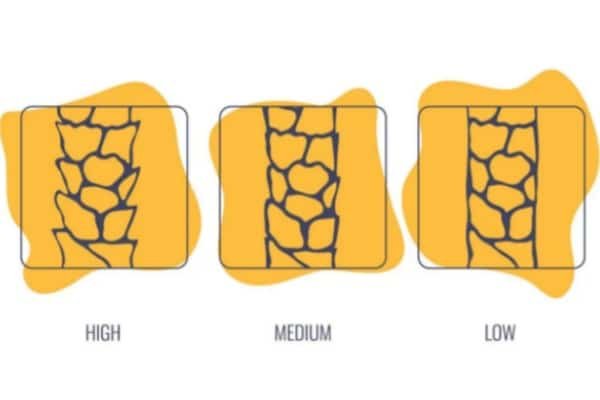
Hygroscopicity: Porous ceramics naturally absorb water vapor. Since water is conductive, a damp coating loses its dielectric strength rapidly.
Sealing Importance: This is why high-quality coated bearings are vacuum-impregnated with resin. The resin fills the pores, blocking moisture entry.
Temperature Effects
Thermal Runaway: Generally, as temperature rises, the dielectric strength of solid insulators decreases. The atomic lattice vibrates more, making it easier for electrons to break free and form a conductive path.
Frequency (Hz) and dV/dt
The Capacitor Effect: High-frequency currents from SiC drives don’t necessarily “break down” the insulation (arc through it). Instead, they capacitively couple across it. The material hasn’t failed, but it is no longer blocking the current effectively.
5. Engineering Selection: What Value Do You Need?
Don’t over-spec or under-spec.
Standard Industrial Motors (<500V)
For standard 400V/480V motors, peak shaft voltages are typically <50V. A standard 100µm coating (rated >1000V Breakdown) offers a massive 20x safety factor.
Medium Voltage & Traction Motors (>1000V)
For 690V or MV motors, shaft potentials can spike to hundreds of volts. Here, the “Enhanced” 300µm coating (rated >3000V) or Hybrid bearings are mandatory to maintain safety margins.
Frequently Asked Questions (FAQ)
What is the difference between insulation resistance and dielectric strength?
Insulation Resistance (Ohms) measures how much current leaks through at a safe voltage. Dielectric Strength (Volts) measures the voltage required to destroy the insulation.
Can dielectric strength degrade over time?
Yes. Thermal cycling, mechanical stress, and chemical degradation (oxidation) can micro-crack the insulation, lowering its breakdown voltage over years of service.
Why is the breakdown voltage of hybrid bearings considered “infinite”?
Because the ceramic balls are so thick (millimeters vs. microns), the voltage required to arc through them is tens of thousands of volts—far higher than any voltage ever generated inside an electric motor.
