

In modern industrial applications, Electric Discharge Machining (EDM) bearing damage—often referred to as electrical erosion—has become a prevalent cause of premature motor failure. As the adoption of Variable Frequency Drives (VFDs) increases to improve energy efficiency and process control, so does the incidence of shaft voltages discharging through motor bearings. For maintenance engineers and plant managers, understanding the mechanics of EDM damage is critical to ensuring equipment reliability.
This technical guide details the root causes of electrical erosion, how to identify distinct symptoms like fluting, and the engineering solutions available to prevent costly downtime.
What is EDM Damage in Bearings? (Definition)
EDM damage in bearings is a failure mode caused by the passage of electrical current through the bearing’s rolling elements and raceways. While “EDM” typically refers to a deliberate manufacturing process, in the context of rotating machinery, it represents an uncontrolled and destructive phenomenon.
The Concept of Electrical Erosion
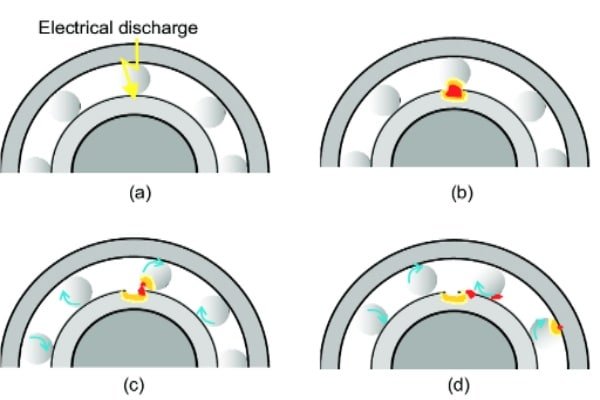
When stray electrical currents pass through a bearing, arcing occurs between the race and the rolling element. This arc generates intense localized heat, melting a microscopic portion of the metal surface. As the bearing rotates, this process repeats thousands or millions of times. The cumulative effect of these micro-welds and subsequent tearing of material is known as electrical erosion.
Why it Happens: The Role of Stray Currents and Shaft Voltages
Electric motors are designed to operate with a magnetic balance. However, parasitic capacitance exists between the stator and the rotor. When shaft voltages accumulate and exceed the dielectric strength of the lubricant film separating the bearing components, the voltage discharges to the ground through the path of least resistance: the bearing.
The Connection Between VFDs and EDM
The rise in EDM issues correlates directly with the widespread use of Variable Frequency Drives (VFDs). VFDs control motor speed by switching voltage on and off at high frequencies using Pulse Width Modulation (PWM). This high-speed switching creates common-mode voltages and high-frequency currents that can easily capacitively couple to the rotor, significantly increasing the risk of electrical discharge damage compared to standard line-driven motors.
Recognizing the Symptoms: Visual and Auditory Signs
Detecting electrical erosion early can prevent catastrophic motor seizure. Diagnosis typically involves vibration analysis, auditory inspection, and visual examination of the bearing components upon disassembly.
Electrical Pitting: The Early Warning Signs
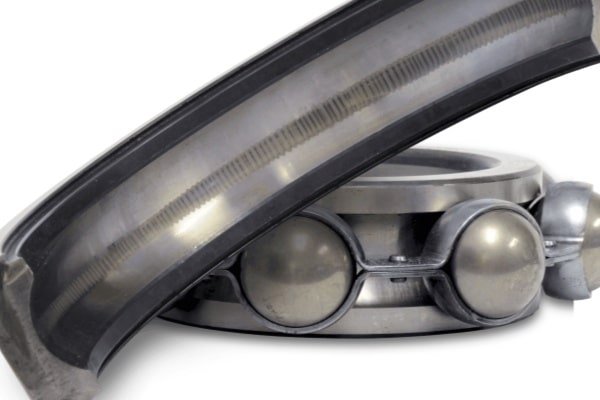
The initial stage of damage appears as pitting. Under a microscope, these look like tiny craters where the metal has melted and re-solidified. To the naked eye, this often manifests as a “frosted” or dull gray appearance on the balls or rollers and the raceways. This surface roughness increases friction and operating temperature.
Fluting: The “Washboard” Pattern on Raceways
The most distinctive signature of EDM damage is “fluting.” As the bearing continues to operate with pitting, the mechanical resonance of the rolling elements moving over the pits creates a rhythmic vibration. This causes the discharges to concentrate in specific bands, carving deep, parallel grooves across the raceway. This “washboard” pattern is a definitive indicator that electrical current, not mechanical load, caused the failure.
Grease Degradation: Why Lubricants Look Burnt
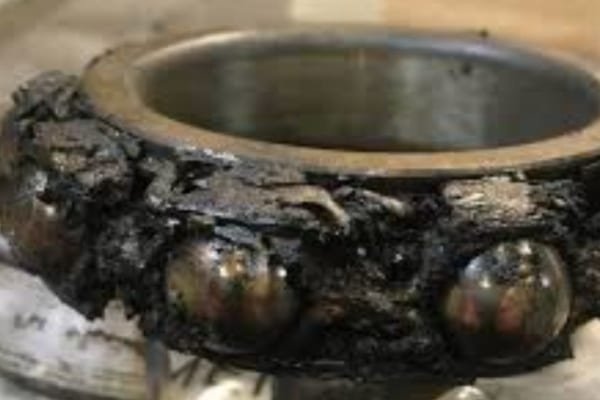
The electrical arcs generated during discharge reach extremely high temperatures. This heat causes the rapid oxidation and carbonization of the lubricating grease. Consequently, the grease often appears black, burnt, or hardened, losing its lubricating properties and accelerating mechanical wear.
Audible Noise and Excessive Vibration
Operators often report a distinct increase in audible noise. Fluting creates a loud, high-pitched whining or a rhythmic “growling” sound that correlates with motor speed. Vibration analysis will typically show harmonics of the ball pass frequency (BPFO/BPFI) with sidebands, indicating a surface defect.
The Mechanics: How Bearing Arcing Occurs
Understanding the physics behind the arc helps in selecting the correct mitigation strategy.
Capacitive Coupling Explained Simply
In a VFD-driven motor, the stator acts as one plate of a capacitor, and the rotor acts as the other, with the air gap serving as the dielectric. The high-frequency switching of the drive charges the rotor (capacitive coupling). Because the rotor is suspended by lubricated bearings, it is electrically isolated from the grounded frame—until the voltage becomes too high.
When the Oil Film Breaks Down
Bearings rely on a thin film of oil or grease to prevent metal-to-metal contact. This oil film acts as an electrical insulator. However, once the accumulated shaft voltage exceeds the “breakdown voltage” of the oil film (typically 5 to 30 volts, depending on film thickness), the insulation fails. The energy discharges instantaneously across the gap, creating the damaging arc.
Common Causes of EDM Damage
While VFDs are a primary source, other factors contribute to the severity of the issue.
- Improper Grounding: If the motor frame is not adequately bonded to the facility ground, high-frequency noise seeks alternative paths.
- High-Frequency Switching: Modern IGBTs (Insulated Gate Bipolar Transistors) in drives switch extremely fast. Higher switching frequencies generate higher magnitudes of common-mode voltage.
- Cable Length and Type: Long, unshielded motor cables can act as antennas, amplifying high-frequency noise and exacerbating voltage spikes at the motor terminals.
How to Prevent EDM Bearing Damage (Solutions)
Preventing electrical erosion requires interrupting the current path or safely bleeding the voltage to the ground.
Using Insulated Bearings
Insulated bearings prevent current from passing through the rolling elements.
- Hybrid Bearings: Use ceramic (silicon nitride) balls which are non-conductive. This is the most robust solution as it eliminates the possibility of current flow through the bearing.
- Coated Bearings: Feature an electrically insulating coating (such as aluminum oxide) on the outer or inner ring. While effective, they must be handled carefully to avoid chipping the coating.
Installing Shaft Grounding Rings (SGR)
Shaft Grounding Rings utilize conductive micro-fibers or carbon brushes to create a low-impedance path from the motor shaft to the grounded frame. This “bleeds” the voltage off harmlessly, bypassing the bearings entirely. This is a common retrofit solution for existing motors.
Correct Cabling and Grounding Practices
Using symmetrical, shielded VFD cables helps contain electromagnetic interference (EMI) and provides a low-impedance path for high-frequency currents to return to the drive, rather than flowing through the motor shaft.
Comparison: Which Solution is Right for Your Motor?
Selecting the right protection depends on motor size, application criticality, and budget.
| Solution | Primary Mechanism | Best Application | Cost Implications |
|---|---|---|---|
| Hybrid Bearings (Ceramic) | Blocks current completely | Critical motors, smaller HP motors, harsh environments | High initial cost; Excellent longevity |
| Shaft Grounding Rings | Diverts current to ground | Standard VFD motors, larger HP motors (100HP+) | Moderate cost; Requires clean shaft surface |
| Insulated Coated Bearings | Resists current flow | Medium to large motors (over 100mm bore) | Moderate to High cost |
Frequently Asked Questions (FAQ)
How quickly can EDM destroy a bearing?
EDM damage can lead to failure in as little as a few weeks or even days after installation, depending on the severity of the shaft voltage and the switching frequency of the drive. Without mitigation, failure is often inevitable.
Can standard grease prevent electrical erosion?
No. While fresh grease has higher dielectric strength, it cannot withstand the voltages generated by modern VFDs indefinitely. As grease ages or becomes contaminated, its insulating properties degrade, accelerating the arcing process.
What is the difference between Brinelling and Fluting?
False Brinelling is mechanical damage caused by vibration when the bearing is static, creating depression marks. Fluting is electrical damage characterized by closely spaced, rhythmic washboard grooves caused by current discharge during rotation.
Do all VFD-driven motors need insulated bearings?
Not necessarily. Small motors (under 10HP) may tolerate some voltage, but it is generally recommended to use shaft grounding or insulated bearings for any critical motor operating on a VFD to ensure reliability.
