
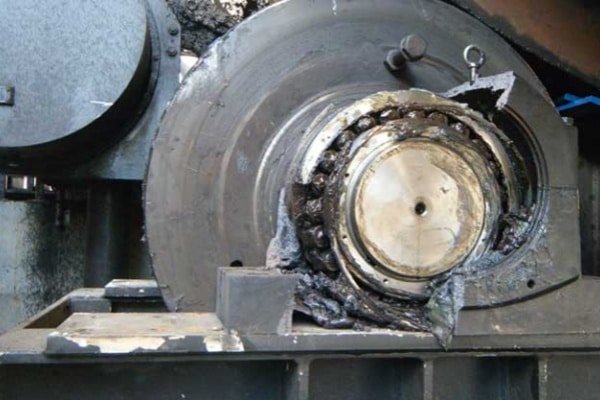

In industrial motor maintenance, the condition of the lubricant is the pulse of the machine. Often, technicians open a failed motor bearing to find the grease has turned into a dry, black, carbonized sludge. While it is easy to blame this on general “overheating” or “old age,” in VFD-driven motors, the true culprit is often electrical discharge. Electrical lubrication breakdown is a rapid, chemically destructive process that usually precedes physical damage to the steel raceways. Understanding this phenomenon is key to diagnosing the root cause of premature failure.
In this technical guide, you will examine:
- The visual and olfactory signs of electrically degraded grease (“burnt” smell).
- The chemistry of “Thermal Cracking” and how electric arcs destroy oil molecules.
- Why carbonized grease acts as an abrasive compound, accelerating wear.
- How to distinguish electrical breakdown from standard thermal oxidation.
- The pros and cons of using conductive grease as a mitigation strategy.
Let’s analyze the chemistry of what happens when a spark meets oil.
The “Burnt Grease” Phenomenon: What It Looks Like
Before the bearing starts screaming, the grease dies silently. Recognizing the early signs can save the motor.
Rapid Blackening
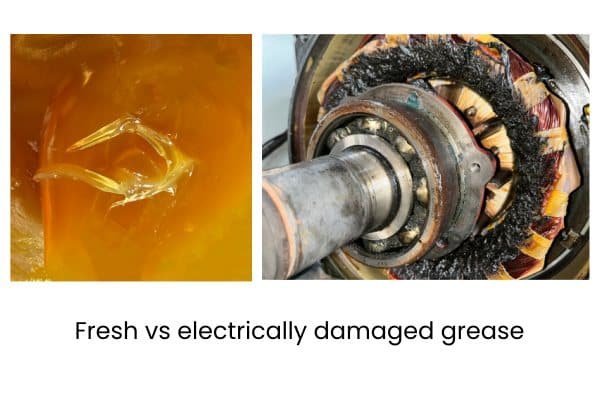
Normal grease darkens slowly over months or years due to oxidation. Electrically damaged grease turns jet black rapidly—sometimes within weeks of operation. This black color is not dirt; it is millions of microscopic carbon particles (soot) generated from the oil itself.
Texture Changes
Healthy grease is oily and buttery. Electrically shocked grease loses its oil content, leaving behind the thickener and carbon residue. It becomes dry, hard, brittle, or sometimes putty-like, losing its ability to flow back into the race to lubricate the rolling elements.
The Smell Test
There is a distinct difference between the smell of old oil and burnt oil. Electrically damaged lubricant emits a sharp, acrid odor similar to burnt wiring or charred plastic, indicating that the base oil has been subjected to extreme temperatures.
The Mechanism: How Electricity “Cracks” the Oil
Why does electricity destroy grease so efficiently? The answer lies in the physics of the arc.
The Arc Temperature
When shaft voltage discharges through the bearing, it creates a plasma arc. While the total energy is low, the energy density is enormous. The core of this microscopic arc reaches temperatures exceeding 3,000°C (5,400°F). No hydrocarbon oil can withstand this heat.
Thermal Cracking Explained
At these extreme temperatures, the long-chain hydrocarbon molecules that make up the base oil instantly fracture. This process is called thermal cracking. The hydrogen and carbon atoms are ripped apart. The hydrogen gas evaporates, while the carbon solidifies instantly.
Carbonization: The Formation of Abrasive Soot
The remaining carbon forms soot. As millions of arcs occur every hour, the grease becomes saturated with this carbon dust. Since carbon is relatively hard, the lubricant effectively turns into a lapping compound (an abrasive paste). Instead of reducing friction, the grease now actively wears down the bearing surfaces, polishing them to a dull gray finish.
Diagnosing: Is it Electrical or Just Overheating?
General mechanical overheating (e.g., from a hot environment or friction) also darkens grease. How do you tell the difference?
Comparing Degradation Rates
Thermal oxidation (mechanical heat) affects the entire bulk of the grease slowly and uniformly. Electrical breakdown is localized at the contact points but contaminates the whole mixture rapidly. If the motor housing is cool to the touch but the grease inside is burnt, suspect electrical discharge.
Analyzing the Debris: The Molten Metal Sign
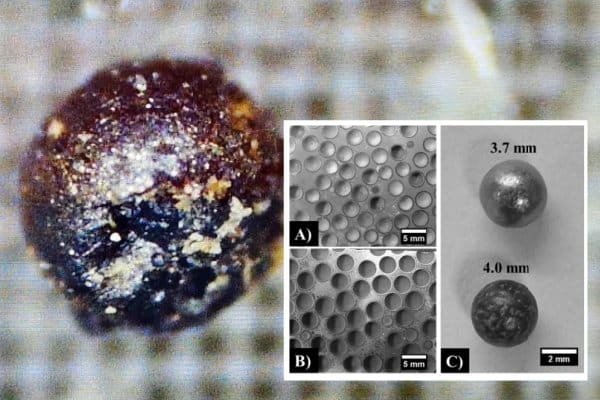
This is the “smoking gun.” If you analyze the grease under a microscope (ferrography), mechanical wear produces jagged metal flakes. Electrical damage produces molten metal spheres. These are tiny droplets of steel that melted during the arc, splashed into the grease, and froze into perfect spheres. Only temperatures from an electric arc can produce these spheres; mechanical friction heat is not hot enough to melt steel.
The Role of Conductive Grease (A Controversial Solution)
Some engineers turn to conductive grease as a fix. Does it work?
How It Works
Conductive grease contains conductive particles (like carbon or silver) designed to bridge the gap between the ball and race, preventing voltage buildup by shorting it out continuously.
Limitations and Risks
While effective for static electricity, conductive grease often fails in VFD applications.
- High Frequency: The high-frequency nature of VFD currents can still degrade the conductive additives over time.
- Shorter Life: Conductive greases often have lower load-carrying capacities and shorter service lives than premium synthetic greases.
- Not a Cure: It treats the symptom, not the cause. Once the grease dries out, the protection is lost. Mechanical grounding (SGR) is generally preferred for long-term reliability.
Frequently Asked Questions (FAQ)
Can simply changing the grease fix electrical noise?
No. Fresh grease restores the dielectric strength temporarily, which might actually stop the arcing for a short time until the voltage builds up higher and blasts through again. The cycle will repeat until the electrical path is addressed.
How long does grease last in a VFD motor without protection?
In severe cases with high carrier frequencies, grease can be chemically destroyed in as little as 3 to 6 months, compared to a normal expected life of 3 to 5 years.
Does synthetic grease resist electrical arcing better?
Synthetic greases (like Polyurea) have better thermal stability than mineral oils, so they withstand the heat slightly better. However, no organic chemical can withstand the 3,000°C heat of an electric arc. Insulation or grounding is still required.
