

Bearing failure is rarely a sudden event; it is often the culmination of microscopic destructive processes. One of the most aggressive yet overlooked mechanisms is electrical arcing. Whether induced by modern Variable Frequency Drives (VFDs) or improper maintenance grounding, electrical arcing silently attacks the bearing’s rolling elements and raceways. At the heart of this damage is a phenomenon known as “microwelding”—a violent thermal event occurring on a microscopic scale.
In this technical guide, you will explore:
- The physics of how electrical potential breaks down the lubricating oil film.
- The concept of “microwelding” and how distinct craters are formed in steel.
- How to visually distinguish electrical arcing marks from mechanical debris.
- Why improper welding practices on machinery can destroy bearings instantly.
- Proven strategies to stop the arc before it starts.
Let’s delve into the science of what happens when a spark jumps the gap inside your bearing.
What Is Electrical Arcing in Bearings? (Definition)
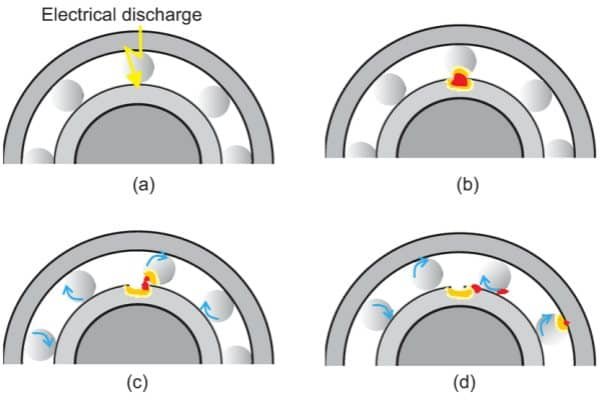
Electrical arcing in bearings occurs when an electric current jumps across the gap between the bearing raceway and the rolling element (ball or roller). Under normal operation, these metal surfaces are separated by a thin film of lubricating oil or grease. This film acts as an electrical insulator (dielectric). However, if the voltage potential across the bearing exceeds the dielectric strength of the lubricant, the film breaks down, and current discharges aggressively through the gap.
The “Capacitor Effect”
The motor acts like a capacitor: the rotor is one conductive plate, the stator is the other, and the air gap is the insulator. Parasitic capacitance allows charge to accumulate on the rotor. The bearing, sitting between the charged rotor and the grounded frame, becomes the release valve for this stored energy.
The Physics of Destruction: How Arcing Happens
The damage is not caused by the electricity itself, but by the intense heat it generates.
The Discharge Event
When the voltage rises high enough (typically 20-30V, but varying with film thickness), it punches a hole through the oil film. This creates a plasma channel—an arc—that conducts the current instantaneously.
The Microwelding Phenomenon Explained
This is the critical damage mechanism. The arc is extremely small but incredibly hot, reaching temperatures up to 4,000°C (7,200°F) in a fraction of a second.
This localized heat spike causes the steel on both the race and the ball to melt instantly. For a microsecond, the two surfaces may fuse together—a process called microwelding. As the bearing continues to rotate, this tiny weld is torn apart. The tearing action pulls a piece of metal out of the surface, leaving a crater (pit) and releasing a molten particle into the lubricant.
From Molten Metal to Solid Debris
The ejected molten steel rapidly cools and solidifies into a hard, spherical particle. These particles circulate in the grease, acting like abrasive contaminants that cause secondary mechanical wear.
Identifying the Signs of Arcing (Visual Guide)
You cannot see the arc happening, but you can see the scars it leaves behind.
Electric Pitting
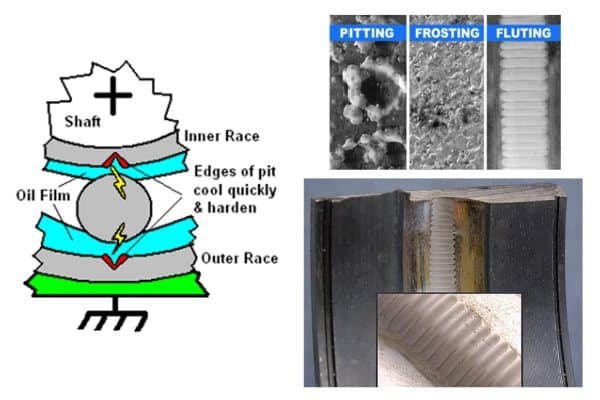
The primary symptom is pitting. Under a microscope, these look like tiny volcanoes or craters with smooth, melted rims. This distinguishes them from the sharp, jagged edges of mechanical spalling.
Frosting
As thousands or millions of arcs occur, the individual pits overlap. To the naked eye, this creates a “frosted” appearance, usually a dull gray band covering the load zone or the entire raceway. The surface feels rough, like fine sandpaper.
Degraded Lubricant
The high temperature of the arcs “cracks” the hydrocarbon molecules in the grease. The lubricant typically turns black, smells burnt, and hardens, losing its ability to protect the bearing.
Primary Causes of Bearing Arcing
Where does the voltage come from?
VFD-Induced Currents
The most common source is the high-frequency common mode voltage generated by VFDs. The rapid switching creates a continuous source of potential that discharges thousands of times per second.
Static Electricity
Belt drives, fans, and conveyors can generate static charge (triboelectric effect) that travels down the shaft to discharge through the motor bearings.
Welding on Machinery (Improper Grounding)
A frequent cause of catastrophic arcing is improper welding practices. If a technician welds on a machine and places the ground clamp on the floor instead of the component being welded, the return current may travel through the motor bearings to get to the ground. This high-amperage current causes massive, severe arcing and immediate destruction.
How to Prevent Electrical Arcing
Prevention focuses on managing the electrical path.
- Low-Resistance Path (Grounding): Install a Shaft Grounding Ring (SGR). This provides a path of least resistance for the current to flow to the ground, bypassing the bearing entirely.
- High-Impedance Barrier (Insulation): Use Insulated Bearings (ceramic coated or hybrid). By making the bearing non-conductive, you remove the path for the current to flow.
- Conductive Grease: While conductive greases exist to bleed off static, they are often ineffective against high-frequency VFD currents and degrade quickly.
Frequently Asked Questions (FAQ)
What is the minimum voltage required to arc through bearing grease?
It depends on the oil film thickness, temperature, and contaminants, but typically arcing can begin at shaft voltages as low as 10 to 30 Volts peak-to-peak.
Does arcing always lead to fluting?
Arcing always causes pitting. Fluting (the washboard pattern) is the secondary result of vibration caused by rolling over those pits. So, pitting comes first; fluting follows if the motor continues to run.
Can microwelding occur in stationary bearings?
Yes, but it is rare unless external current is applied (like welding on the machine). VFD-induced microwelding requires the motor to be spinning to generate the capacitive charge.
