
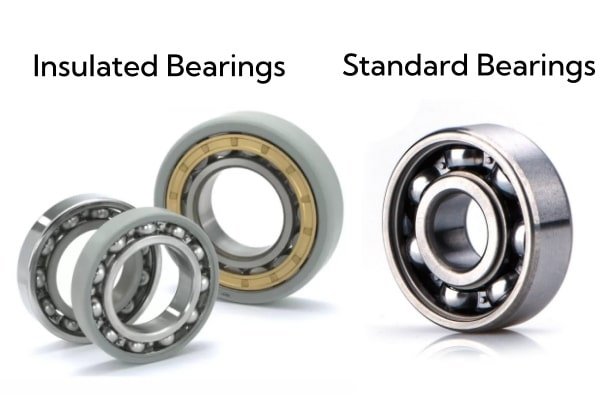

In modern electric motors—especially those controlled by variable frequency drives (VFDs)—bearing insulation has become a critical design element for protecting rotating equipment from electrically induced damage. Understanding how insulated bearings differ from standard bearings helps engineers, maintenance teams, and procurement specialists make more reliable and cost-effective decisions.
Throughout this article, you’ll discover:
- The core structural differences between insulated and standard bearings
- How shaft voltage and bearing currents form in VFD and inverter-duty motors
- Why insulation methods vary and how they affect electrical performance
- Application scenarios where insulated bearings are mandatory
- Cost, reliability, and maintenance implications
- How to choose between insulated and standard bearings using engineering criteria
- Common misconceptions that lead to misapplication or premature failures
Let’s begin by understanding why bearing insulation matters — and where it delivers the most value.
Overview: Why Bearing Insulation Matters in Modern Motors
Bearing currents in VFD and inverter-duty motors
VFDs generate high-frequency switching pulses that create common-mode voltage and shaft voltage within the motor. These electrical potentials seek a discharge path—often through the bearings—resulting in damaging current flow.
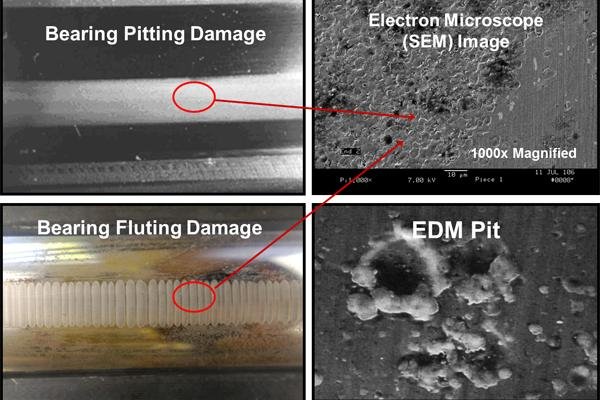
Common failure modes: EDM, fluting, pitting, lubrication breakdown
Electrical discharge machining (EDM) occurs when voltage discharges across the thin lubricating film in a standard bearing. Repeated micro-arcs lead to pitting, fluting, and degraded lubricant, often resulting in catastrophic failure far earlier than mechanical fatigue limits.
When insulation becomes a critical design factor
Insulated bearings block current paths and prevent EDM activity, making them essential for VFD-driven motors, high-voltage machines, and installations with long motor cable runs or high switching frequencies.
Structural Differences Between Insulated and Standard Bearings
Base materials (steel vs hybrid ceramic)
Standard bearings typically use steel rings and rolling elements. Insulated bearings may use the same steel substrate but apply an insulating coating, or they may replace steel balls with ceramic rolling elements to provide inherent electrical isolation.
Insulation methods: ceramic coating, ceramic rolling elements, insulated housings/end shields
Ceramic-coated bearings use plasma-sprayed or oxide-based coatings on the outer ring to achieve high dielectric strength. Hybrid bearings rely on silicon nitride rolling elements to prevent current flow. In some systems, the motor end shields are insulated instead of the bearing itself.
How structure affects heat resistance, stiffness, and load capacity
Ceramic hybrid bearings offer superior heat resistance and lower mass, improving high-speed performance. Coated steel bearings retain traditional stiffness and load capacity while providing robust insulation against electrical discharge.
Durability considerations for high-frequency switching environments
Insulated designs maintain integrity under rapid PWM switching, preventing the surface degradation common in non-insulated units exposed to high-frequency voltage spikes.
Electrical Performance Comparison
How insulated bearings block shaft voltage & common-mode voltage
Insulated bearings introduce a dielectric barrier between the rotating and stationary parts, preventing shaft voltage from forming a discharge path through the rolling contact.
Conductive paths in standard bearings and how EDM occurs
In standard bearings, the lubricant film can break down under electrical stress, allowing arcing between the raceway and rolling element. These discharges remove microscopic material with each event.
High-frequency performance, dielectric strength & breakdown voltage
Ceramic coatings typically withstand 500–2000 V depending on thickness and material. Hybrid ceramic bearings provide even higher resistance, making them ideal for high-frequency VFD applications.
Influence on circulating currents & capacitive discharge
Insulation significantly reduces circulating currents and capacitive discharge events, helping maintain lubrication film integrity and extend bearing life.
Application Differences: When to Use Each Type
Standard bearings — suitable environments & limitations
Standard bearings perform well in fixed-speed industrial motors and general-purpose mechanical systems without VFD exposure. However, they quickly degrade when exposed to shaft voltage.
Insulated bearings — best fit for VFD motors, inverter-duty motors, long cable runs
Insulated bearings are essential when motors experience common-mode voltage, long cable lengths, or high PWM switching frequencies. They provide a reliable electrical barrier that prevents EDM damage.
Industries requiring insulated bearings (HVAC, pulp & paper, mining, oil & gas)
Sectors with large VFD-driven motors use insulated bearings to ensure uptime and reduce maintenance costs, especially where unplanned failures carry high production risk.
Cases requiring combined protection (insulated bearing + grounding ring)
Some systems require both insulated bearings and shaft grounding devices to divert high-frequency currents while preventing circulating current paths.
Performance & Reliability Comparison
Expected lifespan differences
Insulated bearings often last 2–5× longer in VFD environments because they eliminate current-induced wear mechanisms.
Influence on lubricant health and maintenance intervals
With no electrical arcing, lubricant oxidation and degradation slow significantly, extending regreasing intervals.
Vibration, noise signature, and failure probability
Insulated bearings maintain smoother raceway surfaces, reducing vibration amplitude and delaying fatigue-driven wear.
Cost Considerations
Upfront cost difference (standard vs insulated)
Insulated bearings typically cost 2–4× more than standard bearings due to additional manufacturing steps and materials.
Total lifecycle cost and downtime impact
In VFD applications, insulated bearings provide substantial savings by preventing premature failures, reducing maintenance labor, and avoiding costly process interruptions.
ROI when used in VFD/inverter-duty applications
The return on investment is often realized within the first avoided failure event—especially in critical or remote installations.
How to Choose: Selection Guide for Engineers
Motor power rating, voltage class & installation environment
Higher voltage and larger motors require stronger dielectric capability and more robust insulation technologies.
Cable length, switching frequency & harmonic content
Long cables and higher PWM frequencies greatly increase common-mode voltage, making insulated bearings mandatory.
Risk-based decision-making: cost of failure vs cost of prevention
Critical assets, continuous-duty motors, and remote installations justify upgrading to insulated bearings even when electrical stress is moderate.
OEM recommendations & industry standards
Many OEMs specify insulated bearings for all inverter-duty motors 400 V and above, and for any application where shaft grounding alone is insufficient.
Common Misconceptions About Bearing Insulation
“Standard bearings work fine in all VFD motors”
This is false—standard bearings often fail in months when exposed to high-frequency shaft voltage.
“Insulated bearings eliminate all bearing currents”
They eliminate many current paths but do not block high-frequency common-mode voltage unless paired with grounding devices.
“Ceramic hybrid bearings are always better”
Hybrid bearings provide strong insulation but may not be necessary in low-voltage systems where coated bearings offer sufficient protection at lower cost.
Frequently Asked Questions (FAQ)
Do insulated bearings last longer than standard bearings?
Yes—when used in VFD applications, they significantly reduce electrical wear, extending service life.
Can insulated bearings completely prevent EDM damage?
They prevent most discharge events, but complementary grounding may still be required in severe environments.
Are hybrid ceramic bearings the same as insulated bearings?
Hybrid bearings provide insulation through ceramic balls, while insulated bearings rely on coated rings; both serve similar electrical functions but behave differently mechanically.
When should I use insulated bearings vs grounding rings?
Many systems benefit from both—grounding rings divert high-frequency currents, while insulated bearings stop circulating current paths.
Do all inverter-duty motors require insulated bearings?
Most do, especially above 400 V or with long cable runs. OEM specifications should always guide the decision.
