
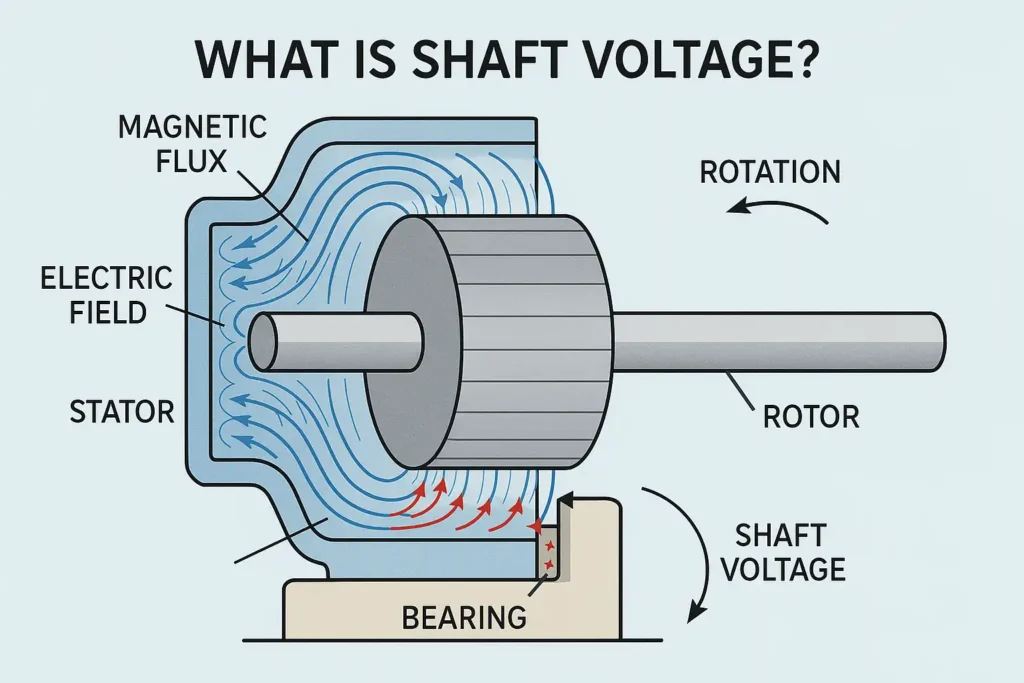

Electric motors—especially those operated by variable frequency drives (VFDs)—can develop unwanted shaft voltage due to electromagnetic and capacitive interactions inside the machine. When this voltage becomes high enough, it discharges through the bearings, leading to electrical damage, premature failure, and costly downtime. Understanding where shaft voltage comes from is essential for specifying the right protective measures in modern industrial systems.
In this complete guide, you will learn:
- The definition of shaft voltage and how it appears on the rotor shaft
- The mechanisms by which VFDs generate common-mode voltage and bearing currents
- How parasitic capacitances, rotor–stator coupling, and asymmetries contribute to electrical stress
- The effects of shaft voltage on bearings—including EDM, pitting, and fluting
- How engineers measure shaft voltage and identify electrical bearing damage
- Effective mitigation techniques such as grounding, insulated bearings, and filtering
- Application-specific considerations for motors of different sizes and environments
Let’s begin by defining shaft voltage and why it has become a critical issue in modern VFD-driven machinery.
What Is Shaft Voltage?
Definition and how voltage appears on the rotor shaft
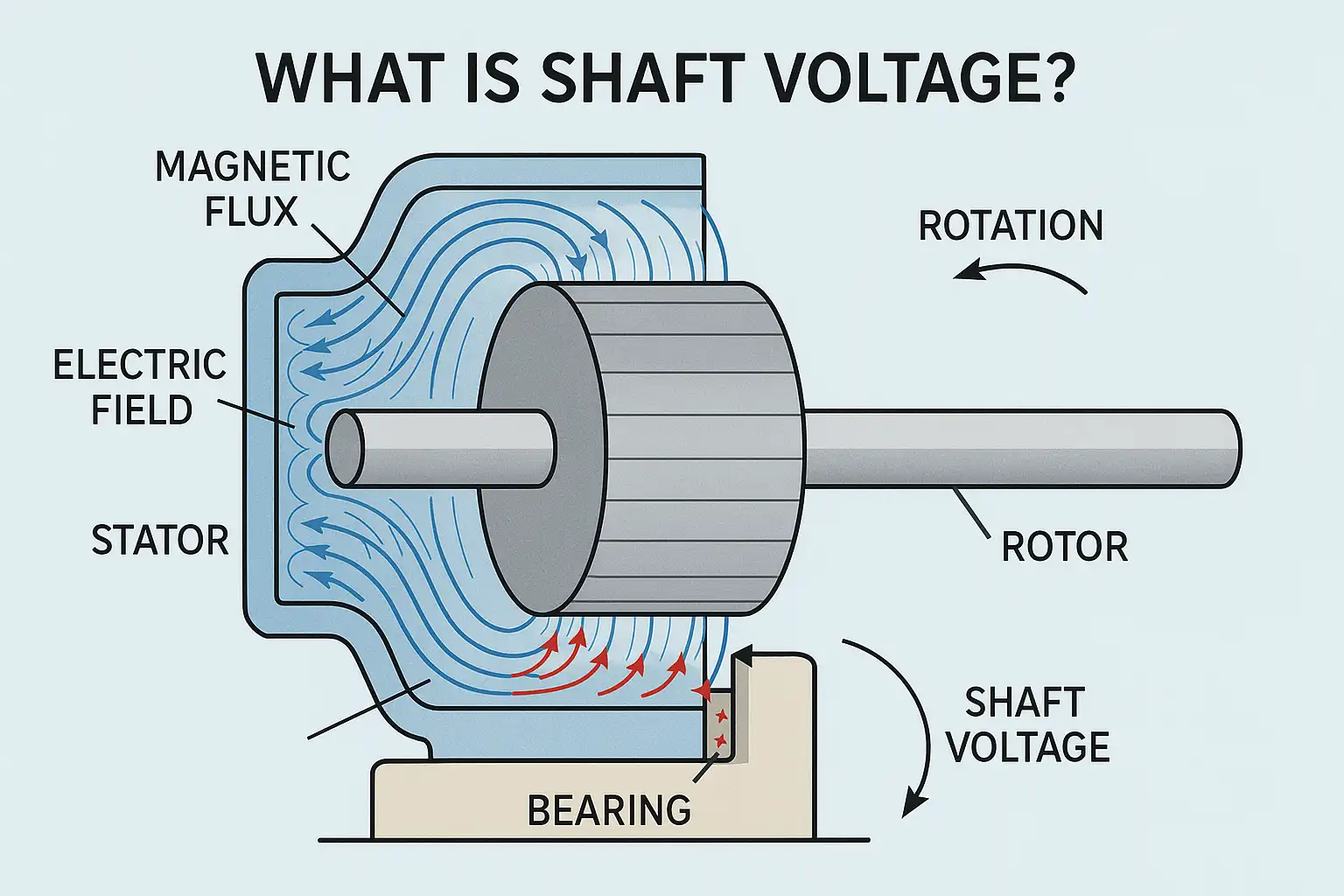
Shaft voltage is an electrical potential that develops between a motor’s rotor shaft and its grounded frame. It is caused by electromagnetic interactions, capacitive coupling, and high-frequency switching effects inside the motor. When this voltage accumulates, it seeks a discharge path—often through the bearings.
Relationship between shaft voltage, bearing currents, and EDM damage
If the bearing’s lubricant film cannot withstand the induced voltage, electrical discharge machining (EDM) occurs. Each discharge removes microscopic metal from the raceway, eventually forming pits and fluted patterns that accelerate bearing wear.
Why shaft voltage is a modern motor reliability issue (especially with VFDs)
Traditional line-powered motors generate minimal shaft voltage. However, modern PWM-based VFDs introduce high-frequency common-mode voltage and rapid switching edges that significantly increase electrical stress on the motor, making shaft voltage a key reliability concern.
Causes of Shaft Voltage in Electric Motors
PWM common-mode voltage from VFDs
VFDs produce pulse-width-modulated output waveforms that create common-mode voltage. This voltage capacitively couples to the rotor and charges the shaft, often reaching levels high enough to break down lubrication film.
Capacitive coupling between stator and rotor
The airgap between stator and rotor forms a parasitic capacitor. High-frequency voltage components transfer energy across this capacitor, raising the shaft potential.
High-frequency switching and parasitic capacitances
Parasitic capacitances exist between windings, end windings, rotor bars, and the motor frame. High-frequency PWM switching excites these capacitances and increases shaft voltage buildup.
Circulating currents in larger-frame motors
In large or high-voltage motors, magnetic imbalances and rotor geometry can induce circulating currents that flow through both bearings unless one side is electrically insulated.
Asymmetries in motor windings or magnetic fields
Uneven phase winding distribution, stator core irregularities, or manufacturing tolerances can create asymmetric magnetic fields that induce voltages onto the rotor shaft.
How long cable runs and grounding systems influence shaft voltage
Long VFD cables increase reflected wave amplitude and common-mode voltage. Poor grounding practices raise impedance and reduce safe discharge paths, causing more voltage to appear on the rotor shaft.
Effects of Shaft Voltage on Bearings
Electrical discharge machining (EDM) inside bearings
EDM occurs when the dielectric strength of the grease film is exceeded. The resulting micro-arcs remove material from the raceways and balls.
Pitting, fluting, and lubrication degradation
Pitting gradually destroys the surface finish. Fluting creates washboard-like patterns that increase vibration. Electrical arcing also oxidizes lubricants, reducing their effectiveness.
Increased noise, vibration, and premature failure
Damaged raceways produce elevated vibration levels and noise signatures, ultimately leading to early bearing failure and rotor instability.
How shaft voltage shortens bearing and motor lifespan
Electrical wear mechanisms often destroy bearings long before mechanical fatigue limits are reached. If left unmitigated, shaft voltage reduces both bearing life and overall motor reliability.
Measurement Techniques for Shaft Voltage and Bearing Currents
Oscilloscope shaft-to-ground measurement
A conductive brush or probe contacts the shaft while an oscilloscope measures shaft-to-frame voltage. Spikes or repetitive pulses indicate harmful electrical activity.
High-frequency current probes
Clamp-on HF probes measure discharge currents flowing through bearing supports or grounding paths. Sudden peaks suggest EDM events.
Vibration signatures of electrical bearing damage
Electrical fluting creates characteristic vibration frequencies distinct from mechanical defects, enabling early detection via condition monitoring systems.
When measurement is necessary (maintenance thresholds)
Measurements become essential when motors are newly installed on VFDs, when cable lengths change, or when vibration and noise indicate possible electrical damage.
Mitigation Methods
Shaft grounding rings/brushes
Grounding devices provide a low-impedance path that directs shaft voltage safely to ground, preventing discharge through the bearings.
Insulated bearings (coated or hybrid ceramic)
Insulated bearings block circulating currents and prevent electrical discharge paths. They are commonly installed on the non-drive end of larger motors.
Insulated motor housings and endshields
Some designs electrically isolate the bearing housings, reducing circulating current loops.
Common-mode chokes, dv/dt filters, sine-wave filters
Filters reduce common-mode voltage and reflected wave amplitude, significantly lowering shaft voltage generation at the source.
Improved grounding and cable management practices
Low-impedance grounding, proper bonding, and shielded VFD cables reduce the likelihood of shaft voltage buildup.
When multiple methods must be used together
Critical or high-power installations often require a combination of grounding, filtering, and insulation for complete protection.
Application Considerations
VFD motors vs line-powered motors
Line-fed motors produce minimal shaft voltage, while VFD-fed motors require mitigation strategies due to high-frequency switching and common-mode voltage.
High-power industrial applications (pumps, compressors, HVAC)
Larger motors experience stronger capacitive coupling and may require insulated bearings plus grounding for reliable operation.
Impact of cable length, switching frequency, and environment
Long cables amplify reflected waves, and high switching frequencies increase common-mode voltage, both contributing to harmful shaft voltage levels.
OEM recommendations and industry standards
Many OEMs specify grounding rings and insulated bearings for inverter-duty motors above certain voltage or power thresholds, aligning with IEEE and NEMA best practices.
Frequently Asked Questions (FAQ)
What creates shaft voltage in VFD motors specifically?
High-frequency PWM switching and common-mode voltage are the primary contributors, amplified by parasitic capacitances inside the motor.
Can shaft voltage occur in motors without a VFD?
Yes, although at lower levels. Magnetic asymmetries, poor grounding, or electrostatic charging can still induce shaft voltage.
How much shaft voltage is harmful to bearings?
Discharge typically begins once shaft voltage exceeds the lubricant film’s dielectric strength—often between 10–20 volts in many motors.
Do insulated bearings eliminate the need for grounding rings?
No. Insulated bearings break circulating current paths but do not stop high-frequency common-mode voltage. Many systems still require grounding rings.
What is the difference between shaft voltage and circulating current?
Shaft voltage is a potential difference that develops on the rotor; circulating current refers to current loops that flow through both bearings in larger motors. They often coexist but arise from different mechanisms.

一条评论
Pingback: Wind Turbine Insulated Bearings: The Ultimate Protection Guide